
The British Museum is one of London’s greatest gifts to travellers. It holds eight million objects from across human history — and entry is entirely free. For US visitors used to paying $25 or more for museum admission, that fact alone makes it worth a visit.
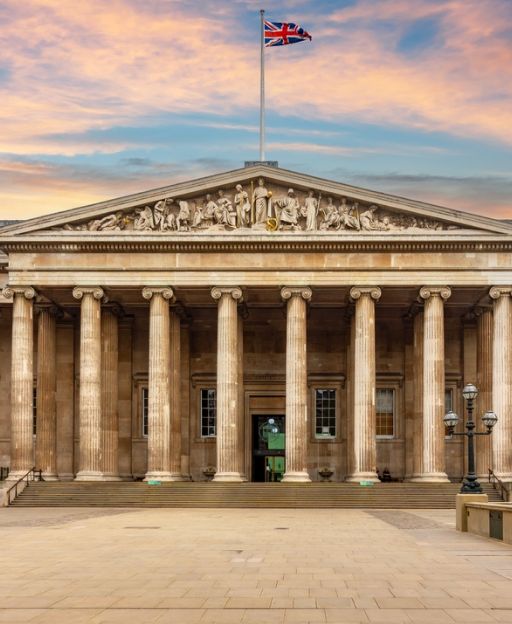
But the British Museum is enormous. Without a plan, you can easily spend four hours and still feel you missed half of it. This British Museum London guide tells you exactly what to see, how long to allow, and how to make the most of your time there.
What Is the British Museum?
The British Museum opened in 1753, making it the world’s first public national museum. It sits in Bloomsbury, a quiet academic neighbourhood in central London. The collections cover two million years of human history — from prehistoric tools to Egyptian mummies to medieval chess pieces.
The building is worth a look before you go inside. The neoclassical facade dates from the 1840s. Once you enter, you step into the Great Court — a spectacular glass-roofed space designed by architect Norman Foster. It surrounds the original Reading Room, where Karl Marx and Charles Dickens once worked.
Enjoying This? Join 3,000+ London Lovers
Get weekly London travel stories, hidden gems, and local secrets delivered free to your inbox.
Subscribe Free →Top Exhibits You Should Not Miss
The museum has over 80 galleries. Here are the rooms worth prioritising on your first visit.
The Rosetta Stone (Room 4)
The Rosetta Stone is the most famous object in the museum. It is a black granite slab carved in 196 BC with the same text in three different scripts. Scholars used it to decode ancient Egyptian hieroglyphics for the first time. Arrive early — it is usually surrounded by visitors and photographers. The stone is smaller than most people expect, but its historical importance is extraordinary.
The Parthenon Sculptures (Room 18)
Room 18 holds some of the finest ancient Greek sculpture in the world. These marble friezes, metopes, and figures came from the Parthenon in Athens. They were carved around 440 BC and show gods, heroes, and Athenian citizens in remarkable detail. Greece has formally requested their return — an ongoing debate. Whatever your view, the sculptures themselves are breathtaking up close.
Egyptian Mummies (Rooms 62–63)
The Egypt galleries on the upper floor draw big crowds for good reason. You can view several mummies up close, alongside their coffins, canopic jars, and everyday objects buried with them. Room 63 gives the best overview of Egyptian burial practices. If you are visiting London with children, this section holds attention exceptionally well.
The Sutton Hoo Helmet (Room 41)
Room 41 covers the Anglo-Saxon period. The star object is the Sutton Hoo helmet — an iron helmet from a 7th-century royal burial in Suffolk. You may recognise it from the Netflix film The Dig. The original is displayed alongside a replica, so you can see what it looked like when complete. The craftsmanship is striking for its era.
The Lewis Chessmen (Room 40)
These carved ivory chess pieces from 12th-century Scotland and Norway are a delight. They were found on the Isle of Lewis in the 1800s. The kings, queens, bishops, and knights have expressive, almost comical faces. Most visitors walk past them — do not. They sit in Room 40, covering medieval Europe, and reward a close look.
The Warren Cup (Room 70)
For visitors interested in Roman history, the Warren Cup is a highlight. It is a solid silver Roman drinking vessel made around 5 to 15 AD, decorated with detailed figurative scenes. The museum acquired it in 1999 for £1.8 million. The craftsmanship is extraordinary, and the piece survived almost 2,000 years intact.
Practical Information for Your Visit
Opening Hours and Admission
The British Museum opens daily at 10am and closes at 5pm. On Fridays, it stays open until 8:30pm. Entry to the permanent collection is free. Some special exhibitions carry an admission fee, typically between £15 and £25.
Book a free timed entry slot in advance during peak season. The museum’s website lets you reserve a slot at no cost. This is worth doing in July and August, when queues at the entrance can be long.
Getting There
The museum is at Great Russell Street, Bloomsbury, London WC1B 3DG. The nearest tube stations are Tottenham Court Road, Holborn, and Russell Square — all within a five-minute walk. If you are unfamiliar with the London Underground, read our complete guide to getting around London before you set out. An Oyster card makes the journey straightforward and inexpensive.
How Long to Spend
Allow at least three hours for a focused visit covering the highlights above. If you want to explore beyond those rooms — into the Asian, Americas, and Islamic collections — plan for four to five hours. The museum rewards slower, more selective visits. Trying to see everything in one day is exhausting and unrewarding.
Tips for First-Time Visitors
A few things that make the visit smoother:
- Arrive when the doors open at 10am to beat the crowds, especially in summer.
- Download the museum’s free app before you arrive. The in-gallery audio commentary is genuinely good.
- Pick up a free map at the information desk inside the main entrance. The layout is not intuitive.
- The museum has two cafes and a restaurant. Both fill up fast at lunchtime. Eat before noon or after 2pm.
- Lockers are available for large bags. There is a small charge.
- The museum shop is excellent for gifts and books. Plan a visit before 5:30pm when it closes.
The British Museum and London’s Other Free Museums
One of the great advantages of visiting London as a US traveller is the number of major museums that charge nothing to enter. Alongside the British Museum, the National Gallery, the Victoria and Albert Museum, the Natural History Museum, and the Science Museum are all free.
Our complete guide to London’s free museums covers all the major options with practical tips for each. If you are spending several days in the city and want to make the most of this, Bloomsbury works well as a base — the British Museum sits at its centre, and several other institutions are nearby.
What Is Near the British Museum?
Bloomsbury is a calm, walkable neighbourhood with a strong literary and intellectual history. The Bloomsbury Group — which included Virginia Woolf and John Maynard Keynes — gathered here in the early 20th century. Blue heritage plaques mark several buildings where famous residents once lived.
The Charles Dickens Museum is a short walk away on Doughty Street. Covent Garden is about 15 minutes on foot to the south. Russell Square park, just across the road from the museum, is a good spot to sit with lunch from a nearby cafe.
If you are planning a broader London itinerary, our guide to London’s neighbourhoods covers Bloomsbury alongside all the other key areas worth exploring.
Visiting With Children
The British Museum is genuinely excellent for families. The Egyptian galleries, the mummies, and the Lewis Chessmen tend to fascinate children of all ages. The museum runs free family trails and activity backpacks on weekends and during school holidays — collect these at the information desk on arrival.
The Great Court is a fun space for children to explore. The glass roof is visually striking. Allow extra time if you are visiting with young children — they often stop at unexpected things and need time to absorb what they are seeing.
A Note on the Collections
Some visitors feel conflicted about the British Museum. Many of its most famous objects were acquired during the British Empire, and several source countries — including Greece, Egypt, and Nigeria — have requested their return. The museum’s position is that it holds these objects as part of a universal collection accessible to all. This is an ongoing debate, and one worth going into the museum informed about.
The museum does acknowledge the origins of its collections. Information panels in each gallery discuss the provenance of key objects. Going in with some background knowledge makes the visit a richer experience.
Frequently Asked Questions
Is the British Museum free to visit for US tourists?
Yes. Entry to the British Museum’s permanent collection is completely free for all visitors, including US tourists. No ticket or booking is required for the main galleries, though some temporary special exhibitions carry an admission fee, usually between £15 and £25.
How long should I spend at the British Museum in London?
Allow at least three hours to see the main highlights — the Rosetta Stone, Parthenon Sculptures, and Egyptian mummies. For a more thorough British Museum London guide experience covering the Asia and Americas collections, plan four to five hours. The museum is very large, so a focused visit works better than trying to cover everything.
What is the best time to visit the British Museum?
Arrive at opening time (10am) to avoid the heaviest crowds, especially during July and August. Friday evenings are quieter, as the museum stays open until 8:30pm. Book a free timed entry slot on the museum website in advance during peak summer season.
Where is the British Museum located in London?
The British Museum is at Great Russell Street, Bloomsbury, London WC1B 3DG. The closest London Underground stations are Tottenham Court Road, Holborn, and Russell Square, all within a five-minute walk. It sits in central London, close to Covent Garden and the West End.
Join 3,000+ London Lovers
Every week, get London’s local secrets, little-known places and travel inspiration — the kind you won’t find in any guidebook.
Subscribe free — enter your email:
Free forever · One email per week · Unsubscribe anytime