
Brixton is unlike any other part of London. Its identity was forged by the arrival of the Windrush generation from the Caribbean in the late 1940s, shaped by the streets that lit up with electric light in the 1880s, and stamped with the birthplace of one of Britain’s greatest musicians. It sits 2 miles south of the Thames, and over half a century it has become the city’s most culturally layered neighbourhood.
The Windrush generation and Brixton’s identity
In June 1948, a ship called the Empire Windrush docked at Tilbury with 492 passengers from Jamaica and other Caribbean islands. Many headed to Brixton, drawn by affordable lodgings near the labour exchange on Coldharbour Lane. Over the next two decades, tens of thousands more followed.
The community that settled here transformed everything about the neighbourhood — its food, its music, its culture, and its politics. Brixton Market became the place in London where Afro-Caribbean groceries could be found when no major supermarket stocked them. Reggae drifted out of front windows on warm evenings. The neighbourhood developed a distinctive sound, smell, and energy that you could not find anywhere else in the city.
Today, Windrush Square sits at the heart of Brixton, named in 1998 to mark the 50th anniversary of that first arrival. The Tate Library overlooks it; the Ritzy Cinema faces it. It remains the civic centre of a neighbourhood that has never forgotten where it came from.
Electric Avenue and the market quarter
Brixton Market began trading in the 1870s along Electric Avenue — a street believed to be among the first in Britain to be illuminated by electric light, back in the 1880s. Eddy Grant immortalised it in his 1982 reggae hit of the same name. More than 140 years after it opened, traders still sell fruit, vegetables, and street food from stalls along a narrow, partly covered street that has barely changed in layout since the Victorian era.
The market now spreads across several covered arcades, each with its own character:
Brixton Village
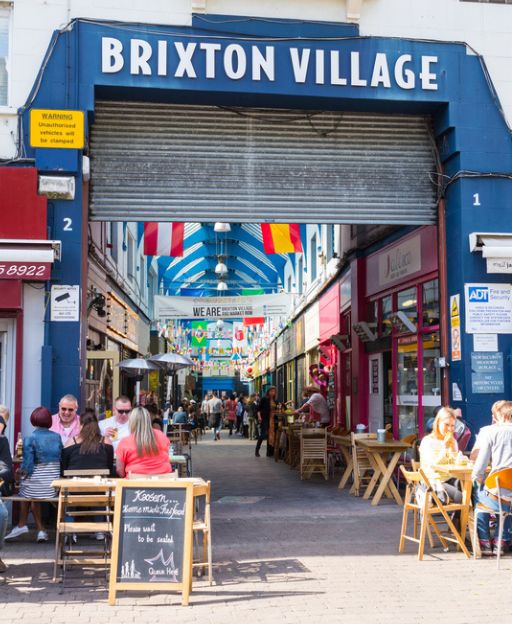
Formerly known as Granville Arcade, Brixton Village opened in 1937 and has been transformed into one of London’s finest covered food destinations. Ethiopian injera, Sri Lankan curries, Colombian arepas, and natural wine bars coexist in a 200-metre arc of independent traders. At weekends, queues form outside the most popular counters before they open. It is busy, loud, and completely alive.
Market Row
Running parallel to Brixton Village, Market Row is quieter and older in feel. Afro-Caribbean hair salons, fishmongers, and fabric merchants who have traded here for decades sit alongside newer arrivals. It gives you a clearer sense of the working Brixton that existed long before the food scene arrived.
Electric Avenue market
The outdoor section of the market runs Thursday through Saturday on Electric Avenue itself. It’s noisier and more crowded than the covered arcades — produce sellers, fish stalls, and street food side by side under the railway arches. Come on a Saturday morning and it is one of the most energetic places in the city.
Enjoying this? 3,000+ London lovers get stories like this every weekday morning. Subscribe free →
David Bowie’s Brixton
David Bowie was born on 8 January 1947 at 40 Stansfield Road, Brixton. He spent only his early childhood here before his family moved north of the river. But the neighbourhood claimed him as its own — and still does.
In 2013, street artist Jimmy C painted a large mural of Bowie’s Aladdin Sane persona on the side of a building on Tunstall Road, near Brixton Underground station. When Bowie died in January 2016, the mural became an overnight shrine — covered in flowers, handwritten messages, and candles for weeks. Television crews set up outside. Fans flew in from across the world.
The Bowie mural still stands. It is not a heritage plaque or a commissioned monument — it is a painting on a railway arch that became sacred because people decided it was. That feels very Brixton.
Pop Brixton and the Ritzy Cinema
In 2015, a cluster of shipping containers was assembled on a vacant plot near Brixton Station Road and became Pop Brixton — a social enterprise housing independent food traders, small businesses, and creative studios. It was designed to give micro-enterprises a foothold in the neighbourhood without pricing out what already existed.
Just around the corner, the Ritzy Cinema on Coldharbour Lane has been showing films since 1911, making it one of London’s oldest continuously operating cinemas. It has a bar, a café, a rooftop terrace, and an independent programming ethos. It is also run as a workers’ cooperative, which tells you something about Brixton’s instincts.
What makes Brixton different from the rest of London
Other inner London neighbourhoods have been thoroughly reshaped by rising rents and new money. Brixton has changed — many long-term residents have been pushed further south by the cost of living — but it has not become uniform. The Brixton Pound, a local currency first issued in 2009, was among the first of its kind in Britain. It was a deliberate act: a community asserting that it had economic relationships worth protecting.
You can still get your hair cut in a barber’s chair that has been there for 30 years, buy plantain from a family that was selling it before Brixton Village became a food destination, and eat a plate of jerk chicken while a sound system plays at midday. That combination is increasingly rare in inner London. Visitors notice it immediately.
Brixton does not perform itself for tourists. It is a working neighbourhood that happens to have one of the best food markets in the country, a world-famous shrine to a rock star, and a history that shaped modern Britain. That combination is worth a morning of anyone’s time in London.
When to visit and how to get there
Brixton is at its most alive on Saturday mornings, when the market runs at full pace and the streets around Electric Avenue fill with movement and noise. Weekday lunchtimes in Brixton Village are excellent too — quieter than weekends, but the food traders are fully open and the atmosphere is genuine. Sunday brings a slower pace; some stalls close, but the main covered arcades stay open.
Brixton Underground station is served by the Victoria line, 12 minutes from Victoria and around 20 minutes from King’s Cross St Pancras. Multiple bus routes connect it to central London and the South Bank. Entry to all the markets is free. Come hungry and give yourself at least two hours.
For help planning the rest of your London trip — transport, timing, and what to prioritise — our complete London planning guide covers everything you need. For more neighbourhood guides, see our guide to London’s best areas, and for the full picture on London’s food market scene, our London food markets guide has every major market covered.
Frequently asked questions about Brixton
What is Brixton most famous for?
Brixton is most famous for its Afro-Caribbean heritage — the Windrush generation settled here from 1948 and shaped the neighbourhood’s culture, food, and music. It is also known as the birthplace of David Bowie, home to the David Bowie mural on Tunstall Road, and the location of one of London’s best market quarters, including Brixton Village and Electric Avenue.
When is the best time to visit Brixton?
Saturday morning is the best time to visit Brixton. The outdoor market on Electric Avenue runs Thursday to Saturday, and Brixton Village is at its liveliest at weekends. Weekday lunchtimes are an excellent alternative — less crowded, with the same quality of food traders open in Brixton Village and Market Row.
How do you get to Brixton from central London?
Brixton is directly served by the Victoria line at Brixton Underground station. It is 12 minutes from Victoria station and around 20 minutes from King’s Cross St Pancras. Multiple bus routes also connect it to the South Bank and other parts of central London. A taxi or rideshare from central London takes roughly 20–30 minutes depending on traffic.
🇬🇧 25 London Places Most Visitors Miss
From secret riverside walks to hidden Victorian tunnels, centuries-old pubs to rooftop gardens with skyline views — our free guide reveals the London most visitors never discover. Join 3,000+ London lovers who get it free.
Get Your Free 25-Places Guide →Know someone who’d love this? Share on WhatsApp →
Love more? Join 64,000 Ireland lovers → · Join 43,000 Scotland lovers → · Join 29,000+ Italy lovers →
Free forever · Unsubscribe anytime