
Hampton Court Palace began as a cardinal’s showpiece and became a king’s playground. Thomas Wolsey started building it around 1515. Henry VIII took it from him in 1528 and made it one of the grandest houses in Europe. Today you can stand under the same red-brick gatehouse that Tudor courtiers rode through, a short train ride from central London.
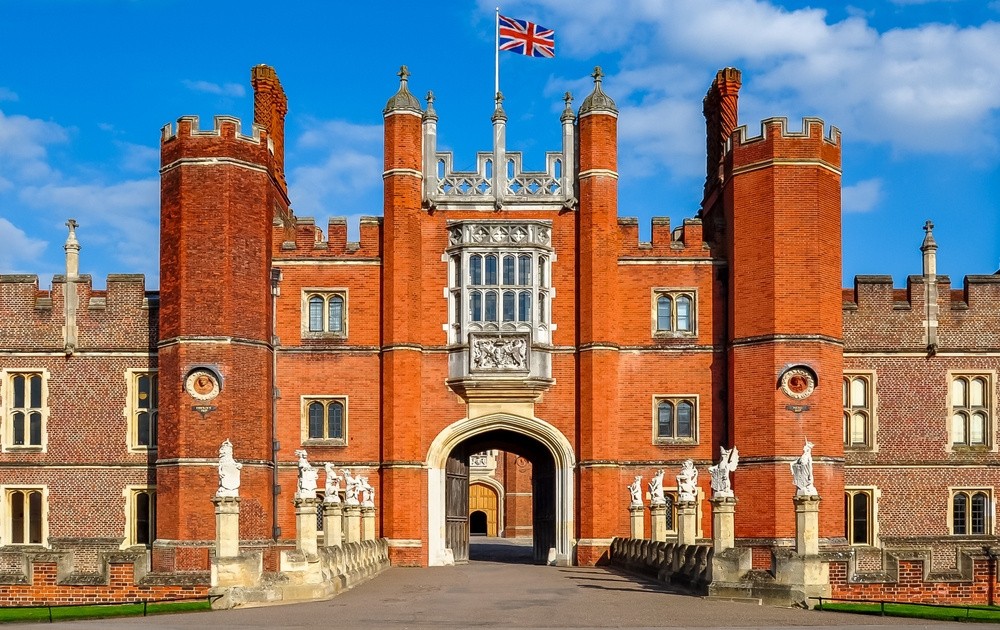
This guide tells the story behind the bricks: who built the palace, what happened inside it, and how the Tudor house gained a Baroque twin. For tickets and opening times, use the official Historic Royal Palaces page. For a day-trip plan, see our Hampton Court Palace day trip guide.
Wolsey builds a palace fit for a cardinal
In 1514, Thomas Wolsey took a lease on the Hampton Court manor from the Knights Hospitaller. Wolsey was Henry VIII’s Lord Chancellor and a cardinal of the Church. He was also the most powerful man in England after the king, and he wanted a house that showed it.
He rebuilt the old manor on a huge scale, using warm red brick, courtyards and a great hall. Wolsey used the palace to host foreign ambassadors and to impress the king himself. Visitors reported rooms hung with tapestries and tables laden with food.
The house also made Wolsey enemies. Courtiers whispered that a mere butcher’s son, as his critics called him, lived better than the king. That jealousy mattered later.
Henry VIII takes over
Wolsey’s fortunes collapsed when he failed to win Henry an annulment from Catherine of Aragon. In 1528 Wolsey handed Hampton Court to the king, hoping to win back his favour. It did not work, and Wolsey died in 1530 before he could face trial.
Henry did not simply move in. He rebuilt. He added the Great Hall with its carved hammerbeam roof, the Chapel Royal and a vast set of kitchens. He also built a tennis court for real tennis, the game that led to modern tennis. The palace turned into a working royal court, with hundreds of servants, cooks, gardeners and officials.
The Great Hall shows what Henry wanted visitors to feel. Craftsmen carved the oak roof with royal badges, and tapestries covered the walls. Henry’s household ate here, and the king used the space to show his wealth to anyone who walked through the door.
🏙️ Enjoying this? 3,000 London lovers get stories like this every week. Subscribe free →
Inside the Tudor kitchens
The kitchens show the scale of Tudor court life better than any throne room. Historians estimate that the royal kitchens fed around 600 people twice a day. Cooks roasted meat on huge spits in fireplaces big enough to walk into. Separate rooms handled pastry, fish, and the cellars where staff kept wine and ale.
Today the kitchens are among the most popular parts of a visit. Costumed interpreters explain how the household worked, and the smell of woodsmoke helps you picture the noise and heat.
Outside, Henry’s gardeners laid out knot gardens and a pond garden, and the Thames brought barges full of supplies to the palace steps. The river was the motorway of Tudor England, and the palace sits right on it for a reason: the royal barge could carry the court between Hampton Court, Westminster and the Tower.
Wives, heirs and the Haunted Gallery
Henry’s six marriages left their mark on the palace. His third wife, Jane Seymour, gave birth to the future Edward VI at Hampton Court in 1537. She died there less than two weeks later. Henry married his sixth wife, Catherine Parr, at the palace in 1543.
Catherine Howard, his fifth wife, has the darkest link. Guards arrested her at Hampton Court in 1541 on charges of adultery, and she went to the Tower of London, where she died. Local legend says her ghost still runs screaming along the Haunted Gallery. That is folklore, not history, but the story keeps the gallery famous.
Henry also gave the palace one of its best-known features, the Astronomical Clock above Anne Boleyn’s Gateway. It dates to around 1540 and shows the sun, the moon and the time of high tide at London Bridge. Boats on the Thames needed that detail.
After the Tudors: Stuarts, a king’s escape and a Bible
The palace stayed in royal use long after Henry’s death. In 1604, James I called the Hampton Court Conference here. That meeting led him to order a new English translation of the Bible, which scholars finished in 1611 as the King James Bible.
In 1647, Charles I came to Hampton Court as a prisoner of the army during the Civil War. He escaped from the palace that November, though his freedom did not last. For the surname hunters among our readers, those war years scattered many English families, and parish records from Surrey and Middlesex can help you trace them.
William and Mary add a Baroque palace
William III and Mary II came to the throne in 1689. They wanted a palace to rival Versailles, so they hired Sir Christopher Wren to rebuild part of Hampton Court. Wren planned to knock down most of the Tudor buildings. Money ran short and Mary died in 1694, so he only replaced the south and east sides.
That is why the palace has two faces. The Tudor side has red brick, battlements and twisting chimneys. The Wren side has symmetrical windows, pale stone and formal gardens. You can stroll from one century into another in a few minutes.
William’s gardeners George London and Henry Wise also planted the famous maze around 1700. Capability Brown became head gardener in 1764 and planted the Great Vine in 1768.
From royal home to public palace
Monarchs stopped living at Hampton Court in the eighteenth century. George II was the last to use it as a home. For decades, the palace housed pensioners and servants of the Crown in grace-and-favour apartments. Queen Victoria opened the palace to the public in 1838, and visitors have come in their millions ever since.
What to look for on your visit
A few details reward a slow look:
- The Tudor gatehouse and its terracotta roundels of Roman emperors.
- The Great Hall roof, carved in oak, with its hanging pendants.
- The Astronomical Clock in Clock Court.
- Wren’s colonnade and the Baroque fountain garden.
- The maze, a puzzle of clipped hedges that has tested visitors for over three centuries.
If you enjoy royal history, read our stories on the Tower of London and the Palace of Westminster. They cover the other end of the Tudor story.
Frequently asked questions
Who built Hampton Court Palace?
Cardinal Thomas Wolsey began the palace around 1515. Henry VIII took it over in 1528 and expanded it. William III and Mary II added the Baroque wings from 1689.
How old is Hampton Court Palace?
The earliest Tudor buildings date to the 1510s, so the palace is more than 500 years old. The Baroque sections date to the 1690s.
Did Henry VIII live at Hampton Court?
Yes. Henry VIII spent much of his reign at Hampton Court. He celebrated Christmas here, married Catherine Parr here and received foreign envoys in its great rooms.
How do I get to Hampton Court Palace from central London?
Trains run from London Waterloo to Hampton Court station, which sits across the bridge from the palace gates. Check the live timetable on the National Rail site before you travel.
Join 3,000+ London Lovers
Every week, get London’s hidden history, heritage walks, and stories from the city’s remarkable past — straight to your inbox.
Subscribe free — enter your email:
Free forever · One email per week · Unsubscribe anytime