
The Imperial War Museum London is the best place in the capital to see how modern war shaped British lives. It sits in Southwark, on the south side of the Thames. Most US visitors need two to three hours, and the museum has a official visitor page with the latest opening and booking details. This guide shows you how to plan the day, what to see, and how to reach it from central London.
Why the Imperial War Museum London is worth your time
Most war museums focus on generals and battles. This one tells the story of ordinary people. You see letters, uniforms, posters, toys and kitchen tools next to tanks and aircraft. That mix makes it easy to follow, even if you know little about military history.
The museum started in 1917, while the First World War was still going on. Its founders wanted to record the war effort of both soldiers and civilians. Today it covers conflicts that involved British or Commonwealth forces from 1914 onwards. That includes the two world wars and many later conflicts.
The building has its own story. It began as the Bethlem Royal Hospital, a famous London asylum once known as Bedlam. James Lewis designed it, and the hospital moved out to Kent. The museum took over the site in 1936 after stops at Crystal Palace and South Kensington. Look up at the green dome as you walk in. It is a good reminder that the walls once held a very different world.
Think about what you want from the visit before you arrive. If you love big machines, spend more time with the aircraft and vehicles. If you prefer people stories, linger over the letters, diaries and home-front displays. Neither plan is wrong, and the museum rewards both.
The two naval guns outside
You will spot the guns before you reach the door. Two huge 15-inch naval guns point out from the front lawn. One came from HMS Ramillies. The other served on HMS Resolution and HMS Roberts. Both fired in action in the Second World War, and they have stood outside the museum since May 1968.
This is the photo spot. Stand on the path in the middle and you can frame both barrels and the green dome together. Go early and you will have the lawn to yourself.
What to see inside
The galleries change over time, so check the official museum page before you go. These are the main draws for first-time visitors:
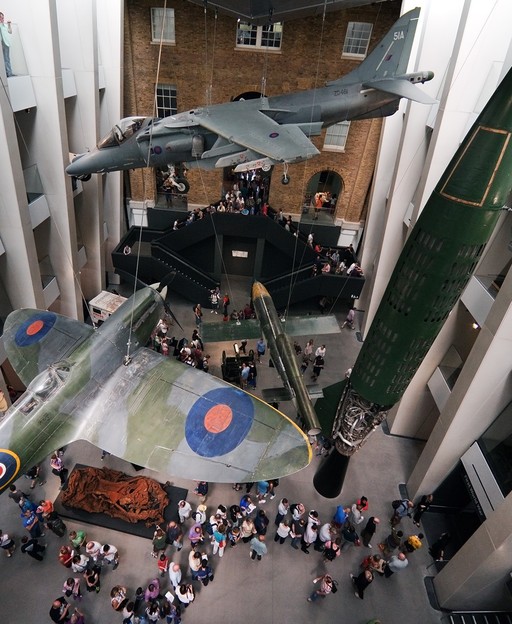
- The central atrium. Foster and Partners redesigned this hall as part of a £40 million project for the First World War centenary in 2014. A Spitfire, a Harrier jet and a rocket fill the open space, as the photo above shows, so you get a feel for the museum right away.
- The First World War galleries. They follow the war from the build-up to the aftermath. They use trench models, personal items and film to show how it felt on the front line and at home.
- The Second World War galleries. Expect stories of the Blitz, rationing and life at home. This part suits families and anyone who has already visited the Churchill War Rooms.
- Aircraft and vehicles. The collection includes a Spitfire that flew in the Battle of Britain, along with other famous aircraft and military vehicles.
- The Holocaust galleries. This is a serious, powerful exhibition. Read the age guidance on the official site, and leave extra time to take it in.
Some special exhibitions need a separate ticket. Check which ones are on before you leave home, because they often sell out at busy times.
25 London places most visitors miss
Riverside walks, City courtyards, centuries-old pubs and rooftop gardens, each with a map link, in one free printable guide. Enter your email and we will send it.
How to get to the Imperial War Museum London
The museum is on Lambeth Road in Southwark. The nearest Tube station is Lambeth North on the Bakerloo line. Elephant and Castle is also close, and it has Northern line and Bakerloo line trains. Waterloo station is a walk of about 15 minutes, which makes it handy if you arrive by train.
Use the Transport for London journey planner to check routes on the day. US visitors can tap in with a contactless bank card or a phone wallet on the Tube and buses. Check that your card has no foreign transaction fee before you travel.
A simple half-day plan
Start with the guns and the front lawn. Then go inside and pick two or three galleries rather than trying to see everything. The museum is large, and tired visitors rush through the last rooms.
Take a break in the museum café or at a bench in the park around it. The grounds once belonged to the old hospital, and they make a calm place to rest. After that, finish the galleries you saved for last.
Jet lag hits hardest on your first day. If you land in the morning from New York, do not book the museum for that afternoon. A day or two later you will enjoy the exhibits much more.
What to see nearby
The museum sits in a quiet corner of the South Bank. These places make good pairings:
- The Garden Museum sits beside Lambeth Palace and suits a slower hour after the heavy galleries.
- The Florence Nightingale Museum at St Thomas’ Hospital tells the story of modern nursing and her work in the Crimean War.
- Shakespeare’s Globe is a short trip along the river, and our planning guide covers tours and shows.
If the war story grabs you, build a second day around it. Read our guide to the Churchill War Rooms, where Britain ran the Second World War from underground. Then see the Tower of London, which has guarded the city for nearly a thousand years. You can also read how the Palace of Westminster rose after the 1834 fire.
Tips for US visitors
- Book any special exhibition ahead of your trip, and check the official page for the latest entry details.
- Wear comfortable shoes. The galleries run across several floors.
- Bring a light layer. London weather changes fast, and the lawn is open to the sky.
- Allow more time if you travel with teenagers who like history. They often stay longer than planned.
- Check the museum site for family trails if you bring younger children.
Frequently asked questions
Is the Imperial War Museum London worth visiting?
Yes. The Imperial War Museum London tells the story of modern war through the lives of ordinary people, which makes it easy to follow. Most visitors say two to three hours is enough for the main galleries.
How do I get to the Imperial War Museum London from central London?
Take the Bakerloo line to Lambeth North, which is the closest Tube station. You can also walk from Waterloo in about 15 minutes.
How long do I need at the Imperial War Museum London?
Plan on two to three hours for a first visit. Add more time if you want to see a special exhibition or the Holocaust galleries.
Is the museum suitable for children?
Many galleries suit families, especially the Second World War displays. The museum gives age guidance for some exhibitions, so read the official page before you bring younger children.