
Portobello Road takes its name from a Spanish port in Panama. A farm on the western edge of London borrowed the name after a famous naval victory in 1739, and the lane that led to the farm kept it. Today the road draws crowds for its antiques, street food and painted houses. This guide follows the story from muddy farm track to world-famous market, and it shows you how to trace the same history on foot in Notting Hill.
How a Victory in Panama Named a London Lane
In November 1739, Admiral Edward Vernon led a small British squadron against Porto Bello, a Spanish silver port on the Caribbean coast of what is now Panama. Britain and Spain had just gone to war, and Vernon took the town with surprising speed. The news reached London weeks later, and the public cheered. Vernon became a national hero almost overnight.
Britons showed their joy by naming things after the victory. Pubs, streets and houses all took the name Porto Bello. One farm on the fields west of London did the same. According to the usual account, the farm took its name from the victory, and the lane running to it took the farm’s name. That lane became Portobello Road.
American visitors may know another link to Vernon. Lawrence Washington, the half-brother of George Washington, served under him. Lawrence later named his Virginia estate Mount Vernon in the admiral’s honour. So the same man gave his name to a famous American house and, indirectly, to one of London’s best-loved streets.
🏛️ Free Guide: How to Trace Your English & British Ancestry
Step-by-step: GRO records, census 1841–1921, parish registers, the National Archives (Kew), London Metropolitan Archives, and planning a heritage trip. Completely free.
Get the Free Guide → Subscribe free at the guide page to receive weekly London heritage storiesFields, Brickworks and a Racecourse
For a long time, the land around Portobello Farm stayed rural. Cows grazed on the fields, and farmers worked the heavy clay soil. In the north of the district, brickmakers dug the clay and fired it in kilns. London needed millions of bricks as it grew, and this corner of the countryside supplied some of them.
In 1837, a racecourse called the Hippodrome opened on the high ground nearby. The organisers hoped to draw London’s wealthy crowds. The plan failed, and the course closed in the early 1840s. The heavy clay made the ground poor for racing, and the owners soon found a better use for the land. They sold it for building.
The Victorian Building Boom
Paddington station opened in 1838, and the railway helped push London westwards. The landowners around Notting Hill saw their chance. Over the next few decades, builders put up tall terraces and curved crescents across the old fields. The Ladbroke family planned much of this development, and they set the houses around shared garden squares. Visitors still enjoy those green spaces today.
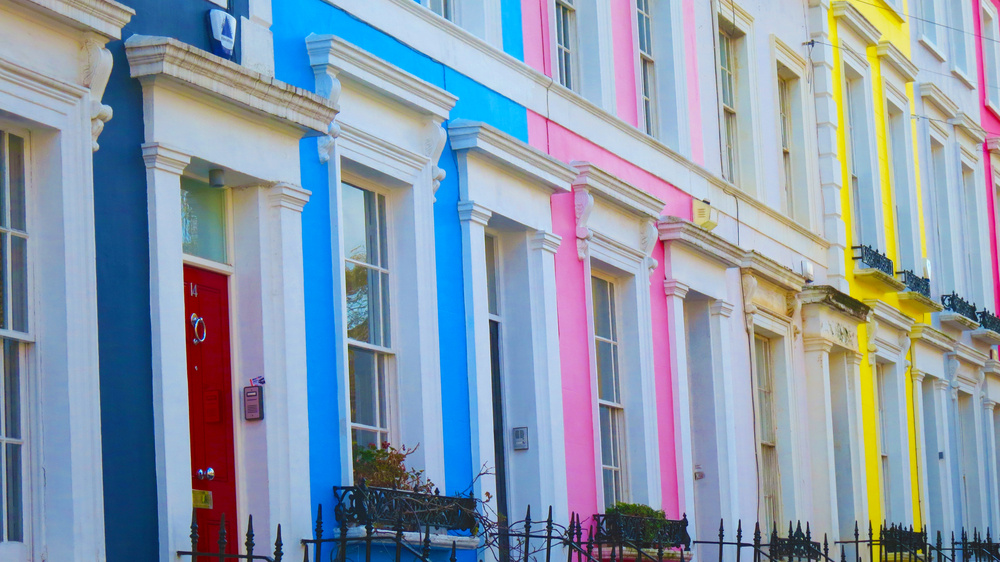
Most of the grand houses used stucco, a smooth plaster made to look like stone. Builders usually painted it a plain cream or white. The bright pinks, blues and yellows you see today came much later. Residents and owners chose them in the last century, and the habit spread street by street. The photograph above shows the result: Victorian stucco fronts, painted in colours the original builders never planned.
Portobello Road itself looked different from the grand streets nearby. Smaller houses, shops and workshops filled its length. The road ran north to south along the old farm lane, so it kept its curving line. You can still see that bend if you look at an old map next to a modern one.
The Potteries and Piggeries
Not everyone in the district lived in a stucco terrace. In the north, near Notting Dale, the old brick pits filled with water and the land turned boggy. Brickmakers and pig keepers built crowded cottages there. People called the area the Potteries and Piggeries, and the name tells you what the neighbourhood looked and smelled like.
Reformers and newspaper writers of the time described the damp homes and the poor health of the families who lived in them. Later builders cleared much of the district and replaced the cottages with new housing. The contrast with the rich terraces a short walk away shaped the area for generations. It also explains why Notting Hill held such a mix of people, trades and incomes by the end of the century.
🏙️ Enjoying this? 3,000 London lovers get stories like this every week. Subscribe free →
How the Street Market Grew
As the houses filled with families, traders followed. In the second half of the 1800s, street sellers began to work along Portobello Road with carts, barrows and simple stalls. They sold fruit, vegetables and household goods to the people who lived nearby. Many of these traders called themselves costermongers, the old London word for a street seller of fruit and vegetables.
The market served local working families first. It did not start as a tourist attraction. Shoppers came for cheap food and everyday goods, and the stalls grew to meet that need. Shops with permanent premises opened behind the stalls, and the road became the busy commercial spine of the district.
From Barrows to Antiques
The antiques trade arrived in the 20th century. After the Second World War, dealers began to set up stalls and small shops along the southern stretch of the road. They found plenty of stock, because many old London houses were selling furniture, silver, clocks and china. Collectors and bargain hunters started to make the trip.
By the middle of the century, the Saturday antiques market had earned a name far beyond Notting Hill. Arcades of small dealers now sit behind the street stalls, and the fruit and vegetable sellers still work the northern end. You can find our wider guide to London’s best street markets in our London markets guide, and a full neighbourhood walk in our Notting Hill guide.
Trace Your Family in Old Notting Hill
If your ancestors lived in west London, the Portobello Road area may feature in your family story. The census records from 1841 to 1921 list households street by street. Search for Portobello Road, Lancaster Road or nearby streets, and read the occupations. You may find brickmakers, costermongers, laundresses, dealers and domestic servants living within a few streets of each other.
Start with these steps:
- Search the census by address, not only by surname, to see the neighbours your ancestors knew.
- Check the parish registers for baptisms, marriages and burials in the Notting Hill and Kensington area.
- Visit the London Metropolitan Archives and the National Archives at Kew for maps, rate books and local records.
- Read the occupation column closely. A costermonger or brickmaker tells you which part of the district your family worked in.
Our guide to tracing your English ancestry explains each of these record sets in more detail. The National Archives website also lets you search many of its collections before you travel.
Visiting Portobello Road Today
The road runs through the heart of Notting Hill. The nearest Tube stations are Notting Hill Gate, Ladbroke Grove and Westbourne Park, and each one leaves you a short walk from a different section of the market. Many visitors begin at the southern end and walk north, so the antiques come first and the food stalls come last.
Saturday is the busiest day, and the antiques dealers cluster at the southern end. Market days, trading hours and street closures can change, so check the official Royal Borough of Kensington and Chelsea website before you go. Arrive early if you dislike crowds, and bring a bag for your finds.
Look up as you walk. The painted terraces on the side streets show Victorian stucco at its most photogenic, and the curve of the road still follows the old farm lane. Every step covers a layer of history, from Admiral Vernon’s victory to the brickworks and the barrow boys.
Frequently Asked Questions
Why is it called Portobello Road?
The road took its name from Portobello Farm, which took its name from Admiral Vernon’s 1739 capture of Porto Bello in Panama. The lane to the farm kept the name.
When did Portobello Road market begin?
Street trading grew along the road in the second half of the 1800s, when the district filled with homes. The antiques trade developed mainly in the 20th century.
Which day is best for the antiques market?
Saturday is the day most visitors choose for the antiques dealers. Check the official council website for current market information before you travel.
Is Portobello Road the same as Notting Hill?
No. Portobello Road is one street inside the wider Notting Hill district. The district also includes the Ladbroke estate, its garden squares and the streets of painted houses.
Join 3,000+ London Lovers
Every week, get London’s hidden history, heritage walks, and stories from the city’s remarkable past — straight to your inbox.
Subscribe free — enter your email:
Already subscribed? Download your free London guide (PDF)
Free forever · One email per week · Unsubscribe anytime