
Walk through the City of London on any weekday and you will see thousands of people rushing past one of the oldest things still standing in Europe. They walk around it, sometimes over remnants of it, and almost never stop to look. That thing is the Roman Wall — built around 200 AD, still partially standing, and almost entirely ignored.
It is extraordinary when you think about it. Two thousand years of history, and most visitors to London have no idea it exists.
What Is the Roman Wall of London?
The Romans founded Londinium around 43 AD. For more than 150 years, the settlement grew without walls — a prosperous trading post on the River Thames with no need for heavy defences.
Then Boudica happened.
In 60 AD, the queen of the Iceni tribe led a revolt that burned Londinium to the ground. The city was rebuilt, but the Romans had learned their lesson. Around 200 AD, they built the wall — a continuous defensive barrier, roughly three miles in circumference, enclosing what is now the financial heart of the city.
It stood about six metres tall. At its base, it was nearly three metres thick. The Romans built it using Kentish ragstone quarried 30 miles away, dragged by barge up the Thames. The effort was immense. The result lasted two millennia.
If you want to understand why London is where it is, why the city’s financial district sits exactly here, why the street plan still feels oddly circular — the Roman Wall is your answer. The medieval city, the medieval lanes, the boundaries of the old square mile: all of them follow lines the Romans drew.
How It Survived Two Thousand Years
The Romans left Britain in 410 AD. For a while, Londinium was abandoned. But the wall remained.
Through the Saxon period, through Viking raids, through the Norman conquest — the wall stood. Not because anyone was especially trying to preserve it, but because it was simply too useful to demolish. Later builders incorporated it into their own structures. Medieval houses were built against it, sometimes using it as a back wall. Centuries of city growth buried parts of it underground.
The Great Fire of 1666 destroyed much of London but left the wall intact — stone doesn’t burn. The Blitz of 1940 actually helped, in a terrible way: when German bombs flattened buildings across the City, sections of the wall that had been hidden inside structures suddenly came back into view.
What you see today are fragments. But some of those fragments are substantial. And they are genuinely Roman.
The Best Places to Find the Roman Wall Today
The wall doesn’t announce itself. You have to know where to look.
Tower Hill
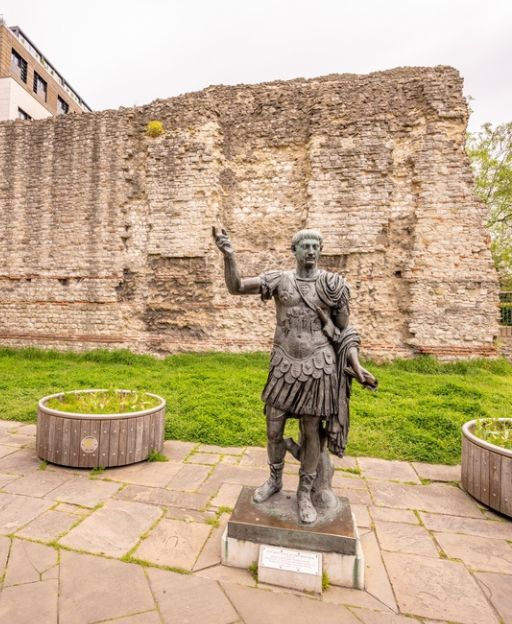
This is the most dramatic surviving section. A large chunk of the original wall stands here, next to a bronze replica of the Emperor Trajan. He raises his arm as if commanding the city below — and behind him, the wall he would have recognised stretches perhaps 30 metres.
It is an extraordinary spot. Step back from the crowds of Tower of London tourists, cross to the small garden behind Tower Hill station, and you are standing next to something that was already ancient when the first stones of the medieval city were being laid.
St Alphage Garden
Just north of London Wall street (yes, the street is named after it), this quiet garden contains one of the more substantial remaining sections. The wall here shows the Roman stonework at the base, with medieval additions clearly visible on top — you can literally see two civilisations stacked on top of each other.
It is one of the best spots in London to sit quietly and think about time.
Noble Street
Near the Guildhall, Noble Street has a long section of wall exposed along the pavement. Again, it’s the kind of thing you could walk past without noticing. But look: that is Roman concrete. That is ragstone pulled from Kent by hand.
Cooper’s Row
Near Fenchurch Street, Cooper’s Row has another impressive stretch, now incorporated into the side of a hotel building. The wall is visible from the pavement and, to their credit, the hotel has left it exposed. You can walk right up to it.
Enjoying this? 3,000+ London lovers get stories like this every week. Subscribe free →
The Queen Who Made It Necessary
To understand the wall, you have to understand Boudica.
She was queen of the Iceni tribe in what is now East Anglia. When her husband died, the Romans moved in — seizing land, enslaving people, flogging Boudica herself. Her response was to raise an army and burn three Roman cities to the ground.
Londinium was one of them. The Romans abandoned the city rather than face her. Boudica’s forces arrived and destroyed it completely. The archaeological evidence of that destruction — a layer of burned red clay — can still be found beneath the streets of the City of London today.
Read more about Boudica and where to find her statue in London.
The Romans rebuilt. And this time, they built walls.
How to Walk the Roman Wall Route
The City of London Corporation has waymarked a Roman Wall Walk — a self-guided route that takes in all the major surviving sections. It starts at the Tower of London and ends at the Museum of London, where you can see Roman artefacts found during excavations. The whole walk takes about two hours at a gentle pace.
Start at Tower Hill. Walk north past Cooper’s Row, then west along London Wall street itself, pausing at the sections near the Barbican and St Alphage Garden. Continue to Noble Street, then finish at the Museum of London on London Wall.
The walk is free. You do not need to book. The wall doesn’t close.
For more on planning your time in the city, the London planning guide covers everything you need before you visit.
What to Look For When You Find It
Not all of the wall looks the same. Spend time at a section and you’ll start to notice the layers.
The Roman stonework is at the bottom — rough, irregular blocks of grey-brown ragstone, sometimes with red tile bonding courses running horizontally. These are distinctive. Whenever you see red tile courses in an ancient wall, you are almost certainly looking at Roman work.
Above the Roman base, the stones become more regular. That’s the medieval additions, when the Norman and later medieval city repaired and raised the original wall. Two building traditions, one wall.
The ragstone itself is remarkable. It was quarried near Maidstone in Kent, loaded onto barges at Hythe, and transported by sea and river to Londinium. The logistics of quarrying, transporting, and placing an estimated 85,000 tonnes of stone, two thousand years ago, are staggering.
Frequently Asked Questions
Where is the best place to see the Roman Wall in London?
Tower Hill is the most dramatic section, with the Trajan statue for scale and a long stretch of original wall visible. St Alphage Garden, near the Barbican, is the best for seeing both Roman and medieval layers side by side.
Is it free to see the Roman Wall?
Yes, all surviving sections of the Roman Wall visible from the street are free to visit. The Museum of London, which has exhibits about Roman Londinium, was also free before its move to the new site at West Smithfield — check current access at the new venue.
How old is the Roman Wall of London?
The main wall was built around 200 AD, making it approximately 1,800 years old. The Roman settlement of Londinium itself dates from around 43 AD, following the Roman invasion of Britain.
How long does the Roman Wall Walk take?
The City of London’s self-guided Roman Wall Walk takes roughly two hours at a leisurely pace. It covers around two miles and includes all the major surviving sections, from Tower Hill to the former Museum of London site on London Wall street.
Stand at Tower Hill on a Tuesday morning. Watch the commuters pour out of the Tube. Most of them will not look up at the wall. Most of them will walk straight past the ragstone blocks that have been standing since Britain was a corner of the Roman Empire.
That is London’s gift — and its strange magic. History this old is simply part of the furniture.
🇬🇧 25 Hidden Gems of London Most Tourists Never Find
From secret riverside walks to hidden Victorian tunnels, centuries-old pubs to rooftop gardens with skyline views — our free guide reveals the London most visitors never discover. Join 3,000+ London lovers who get it free.
Get Your Free London Hidden Gems Guide →📲 Know someone who’d love this? Share on WhatsApp →
Love more? Join 65,000 Ireland lovers → · Join 43,000 Scotland lovers → · Join 29,000+ Italy lovers →
Free forever · Unsubscribe anytime
Subscribe Free