
The address didn’t exist. Not when Arthur Conan Doyle first wrote it down, not when millions of readers fell in love with the man who lived there. Yet today, 221B Baker Street is one of the most visited addresses in London — and the queue outside stretches around the corner most mornings.
Conan Doyle was writing fiction, not a postal directory. He wanted a believable address — something middle-class, respectable, in a part of London his readers would recognise. Baker Street fit perfectly. The number 221 felt plausible. What he didn’t anticipate was that the address would outlive almost everything else he ever wrote — and that one day, it would be real.
How Conan Doyle Chose an Address That Didn’t Exist
When A Study in Scarlet was published in 1887, Baker Street’s numbering only ran to around 85. There was no 221. No 221A. Certainly no 221B. Doyle simply picked a number that sounded right for a respectable Marylebone flat.
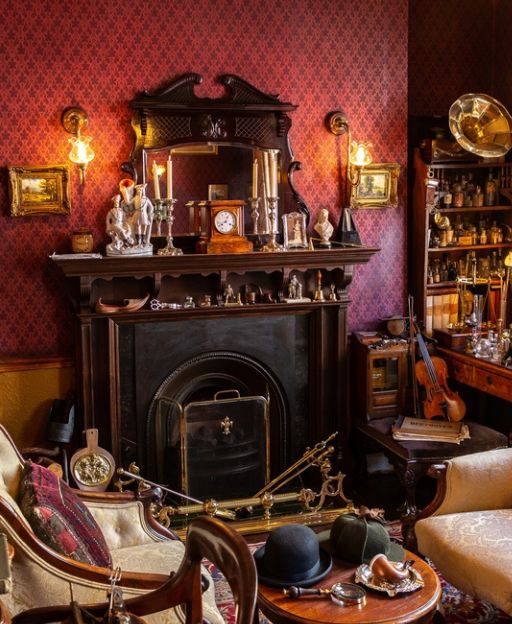
He’d done his research in other ways. He set Holmes in a first-floor study, on a quiet street, within cab distance of Scotland Yard. He described the rooms in extraordinary detail — a chemical corner, a violin, a Persian slipper on the mantelpiece packed with tobacco, unanswered correspondence pinned to the wall. The specific number, though, was imaginative licence.
For nearly half a century after the first story appeared, the address remained entirely fictional. Letters sent there were returned. The man to whom they were addressed, of course, was never real — but the address felt real enough that people kept writing anyway.
The Day 221B Became a Real Address
In the 1930s, Baker Street was extended and renumbered. A large office block went up at 219–229 Baker Street, and suddenly 221B existed on the official postal register. The building was later taken over by the Abbey National Building Society — a thoroughly respectable British bank with no particular interest in detective fiction.
The letters arrived almost immediately. Addressed to Mr Sherlock Holmes, 221B Baker Street. They came from all over the world. Requests for help solving local crimes. Questions about obscure cases from the stories. The occasional marriage proposal. Abbey National employed a dedicated secretary whose sole job was to read these letters and respond — politely, in character — on behalf of the world’s most famous fictional detective.
It was, by most measures, one of the stranger roles in the British financial services industry.
Two Buildings, One Address, a Very British Dispute
In 1990, the Sherlock Holmes Museum opened on Baker Street, intending to recreate the rooms exactly as Doyle had described them. There was just one problem: the museum sits at what is technically 239 Baker Street, not 221.
The local council granted special permission to use the 221B designation. Abbey National was not pleased. They had been managing the address for decades and considered it a point of institutional pride. A polite but persistent dispute ran for years, conducted largely through letters to the council and mildly indignant press releases — which is, somehow, exactly the kind of correspondence Sherlock Holmes might have generated himself.
When Abbey National moved out in 2002, the Royal Mail quietly redirected all mail addressed to 221B to the museum. The museum now holds the official address. The letters still arrive every week.
Enjoying this? 3,000+ London lovers get stories like this every week. Subscribe free →
Inside the Study at 221B
Step through the famous black door and climb the seventeen steps to the first floor. The study is exactly as Doyle described it: a Persian slipper on the mantelpiece, unanswered letters skewered with a jackknife, a violin propped against the wall, a chemistry corner with its glass apparatus. A deerstalker and a pipe sit on the table. Everything is in its place.
The museum runs across three floors. Mrs Hudson’s kitchen on the ground floor, the study above, Watson’s bedroom on the third. Wax figures in period dress appear around corners. Visitors often go very quiet when they first walk in — as though they half expect Holmes to step out of the back room and explain what they’ve been doing all week.
If you’re planning this visit as part of a wider trip, the London planning guide covers everything from neighbourhoods to day trips from the city.
Baker Street Beyond the Stories
Baker Street has its own independent history, entirely separate from Holmes. The street was developed in the 18th century by Sir Edward Baker, after whom it was named. By the Victorian era it was a desirable Marylebone address — solid Georgian townhouses, quiet enough to be respectable, busy enough to be convenient.
The Bakerloo Underground line, which opened in 1906, took its name from Baker Street Station. The platforms still carry Sherlock Holmes tiling — silhouettes of the detective’s profile in the Victorian tilework. The station itself is one of the originals of the London Underground network.
If the idea of a London address becoming a global pilgrimage site appeals to you, the story of Abbey Road Studios is worth reading next — another ordinary street transformed entirely by what happened there.
The Neighbourhood Worth Exploring
Marylebone — the area surrounding Baker Street — is one of London’s quieter pleasures. Georgian streets with good bookshops. An excellent Saturday farmers’ market. Chiltern Street, just a few minutes’ walk, has some of the best independent shops in the city.
The Wallace Collection, fifteen minutes on foot from Baker Street, is one of London’s greatest free museums — an 18th-century mansion packed with Old Masters, armour, and Sèvres porcelain, visited by a fraction of the crowds that queue at the National Gallery. It rewards the walk.
Regent’s Park is close too — one of the Royal Parks, with a rose garden, an open-air theatre, and in summer, the kind of afternoon that makes you understand why Londoners are so protective of their green spaces.
Why People Still Come
Sherlock Holmes is, by most estimates, the most-portrayed fictional human character in film and television history — with over 250 actors taking the role across various productions. BBC’s Sherlock brought a generation of new fans to Baker Street in the 2010s. The Robert Downey Jr films sent American tourists searching for 221B for the first time. Jeremy Brett’s definitive portrayal in the 1980s Granada series still draws devotees who grew up with it.
Each generation discovers Holmes afresh. And each generation, sooner or later, ends up on Baker Street.
There are streets in London with blue plaques for people who actually lived there — Dickens, Byron, Jimi Hendrix. Baker Street has a plaque too. It honours someone who never existed at all. That feels like exactly the kind of detail Holmes would have noted with quiet satisfaction.
Is the Sherlock Holmes Museum worth visiting in London?
Yes — particularly if you’re a fan of the stories or travelling with children. The Victorian rooms are meticulously detailed and the experience is genuinely immersive. Book tickets in advance as queues at weekends can be long.
Where exactly is 221B Baker Street?
The Sherlock Holmes Museum is at 221B Baker Street, London NW1 6XE, a short walk from Baker Street Underground Station, served by the Bakerloo, Metropolitan, Jubilee, Circle, and Hammersmith & City lines.
How long does a visit to the Sherlock Holmes Museum take?
Most visitors spend around 45 minutes to an hour exploring the three floors. Allow extra time for the gift shop and the queue to enter — especially on Saturday mornings and during school holidays.
What else is near Baker Street worth seeing?
Marylebone High Street is a ten-minute walk, with excellent independent shops and cafés. Regent’s Park is close by for a green escape. The Wallace Collection — a free world-class art museum — is fifteen minutes on foot and well worth the detour.
🇬🇧 25 Hidden Gems of London Most Tourists Never Find
From secret riverside walks to hidden Victorian tunnels, centuries-old pubs to rooftop gardens with skyline views — our free guide reveals the London most visitors never discover. Join 3,000+ London lovers who get it free.
Get Your Free London Hidden Gems Guide →📲 Know someone who’d love this? Share on WhatsApp →
Love more? Join 65,000 Ireland lovers → · Join 43,000 Scotland lovers → · Join 29,000+ Italy lovers →
Free forever · Unsubscribe anytime
Subscribe Free