
Most visitors to London spend their mealtimes fighting for a table at Borough Market or queuing at a chain coffee shop on the Strand. But a few streets behind the bustle of Farringdon and Angel, there is a street that Londoners have been quietly choosing over everywhere else for more than a hundred years. It is called Exmouth Market, and it does not advertise itself.
A Street That Never Made the Guidebooks
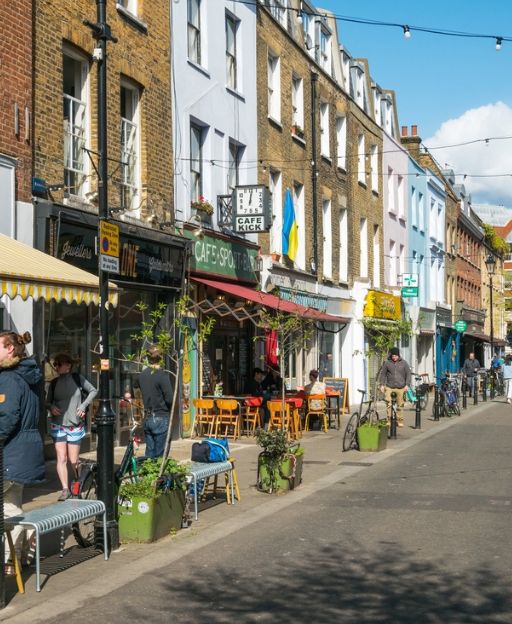
Exmouth Market runs for about 400 metres through Clerkenwell, EC1. It is semi-pedestrianised, meaning it exists in that useful state between a proper road and a high street, and on any given weekday lunchtime you will find office workers, architects, graphic designers and chefs crowding around its outdoor tables.
🏙️ Love London?
3,000 London lovers get hidden history, street-level stories, and local secrets every week. Free, forever — no spam, unsubscribe any time.
Subscribe free — enter your email:
The street has around forty independent businesses. There is not a chain restaurant in sight. This is not luck. It is the result of a community that worked out early on that the moment the chains arrive, something essential gets lost.
You do not come to Exmouth Market for a uniform experience. You come because you heard about the Ethiopian place on the corner, or a friend mentioned the cheese shop, or you once had a lunch here that you could not quite stop thinking about.
Where Costermongers Once Called Out to the Crowd
The market history here goes back to the 1890s. Before the coffee shops and restaurants, Exmouth Market was a working street market where costermongers sold fruit, vegetables and household goods from barrows. Clerkenwell was then one of London’s great working-class neighbourhoods — home to clock-makers, printers, leather workers and Italian immigrants who had settled around Farringdon.
The street took its name from Admiral Edward Pellew, 1st Viscount Exmouth, who led British forces at the Battle of Algiers in 1816. His name remains over the street. His story has largely been forgotten.
By the mid-twentieth century, Exmouth Market had declined, as so many of London’s neighbourhood markets did. The barrows went. The buildings aged. Clerkenwell slid in and out of fashion for decades, never quite arriving at the status of Soho or Notting Hill, always remaining a little too practical and a little too real.
That ordinariness is what saved it.
The Friday Ritual That Locals Guard Carefully
On Fridays, something changes on Exmouth Market. The food stalls arrive. By noon, the street is full of the smell of grilling meat, freshly baked bread and strong coffee. There are perhaps a dozen stalls on a busy Friday — Ethiopian injera, Argentine empanadas, handmade pasta, Korean bao. The mix changes slightly each season, but the ritual stays the same.
Londoners who work in the area treat this like a weekly appointment. They have their usual stall. They know the names of the people who run it. They arrive at a particular time to avoid the queue.
This is what London food culture actually looks like when nobody is filming it for social media. It is local, loyal and surprisingly resistant to hype.
The area around Exmouth Market — Clerkenwell and Farringdon — is one of London’s great design and media districts. The offices here house architects, publishers and creative agencies. These are people with strong opinions about food. That the street has kept its independent character despite thirty years of gentrification pressure says something about what Londoners are willing to fight for.
What Clerkenwell Has That the West End Has Lost
The geography helps. Exmouth Market sits in a part of London that tourists rarely reach unless they are looking for it. It is close to the Barbican and the City, near enough to the Angel to feel connected, but far enough away to feel like its own thing.
Clerkenwell itself has one of the richest histories of any inner London neighbourhood. The Knights of St John had their priory here in the twelfth century. The Peasants’ Revolt of 1381 reached these streets. The radical tradition runs long and deep through the area’s bones.
That history gives the neighbourhood a character that newer developments cannot manufacture. When you sit outside one of the cafes on Exmouth Market on a spring afternoon, you are sitting in a place that has been argued over, built up, knocked down and rebuilt by generations of people who cared about it.
If you want to understand how different parts of London grew their own identities, our London neighbourhood guide gives a fuller picture of which areas reward that kind of slow, deliberate exploration.
What Keeps Drawing People Back
Exmouth Market is not the most famous street in London. It is not the most photographed, the most written about, or the easiest to explain to visitors who want a clear story.
What it is, is consistent. The coffee is good. The food is interesting. The people who run the shops have chosen to be here. On a busy Friday, you will find a table if you look for one, and by the time you leave you will have had exactly the kind of meal that London does best — not a performance, not a destination, just a good thing in a good place.
That is a harder thing to find than most visitors realise. Borough Market has its spectacle. The West End has its convenience. Exmouth Market has something rarer: the sense that it exists for the people who live and work nearby first, and for everyone else second.
London’s food scene has a habit of creating places like this and then slowly destroying them through success. For now, Exmouth Market has avoided that fate.
If you find yourself in Clerkenwell on a weekday lunchtime, follow the smell of good coffee and the sound of people who know each other’s names. To plan the rest of your visit around London’s less obvious pleasures, our London trip planning hub is the right place to start. And if you want to understand the working-class food traditions that shaped everything from these street markets to the classic East End table, the story of the dish that survived the Blitz and gentrification tells you everything you need to know.
🇬🇧 25 Hidden Gems of London Most Tourists Never Find
From secret riverside walks to hidden Victorian tunnels, centuries-old pubs to rooftop gardens with skyline views — our free guide reveals the London most visitors never discover. Join 3,000+ London lovers who get it free.
Get Your Free London Hidden Gems Guide →Love more? Join 65,000 Ireland lovers → · Join 43,000 Scotland lovers → · Join 30,000 Italy lovers →
Free forever · Unsubscribe anytime