
Most people who visit the Natural History Museum in South Kensington think they know what’s inside. A blue whale. A few dinosaur bones. Maybe a diplodocus if they remember from a school trip.
What they don’t know is that behind those grand terracotta arches lies one of the most extraordinary collections on earth — and 95 per cent of it is locked away from public view.
The museum doesn’t hide it on purpose. The collection is simply so vast, so old, and so strange that there’s nowhere near enough space to put it all out at once.
The Building Is Already Telling You a Secret
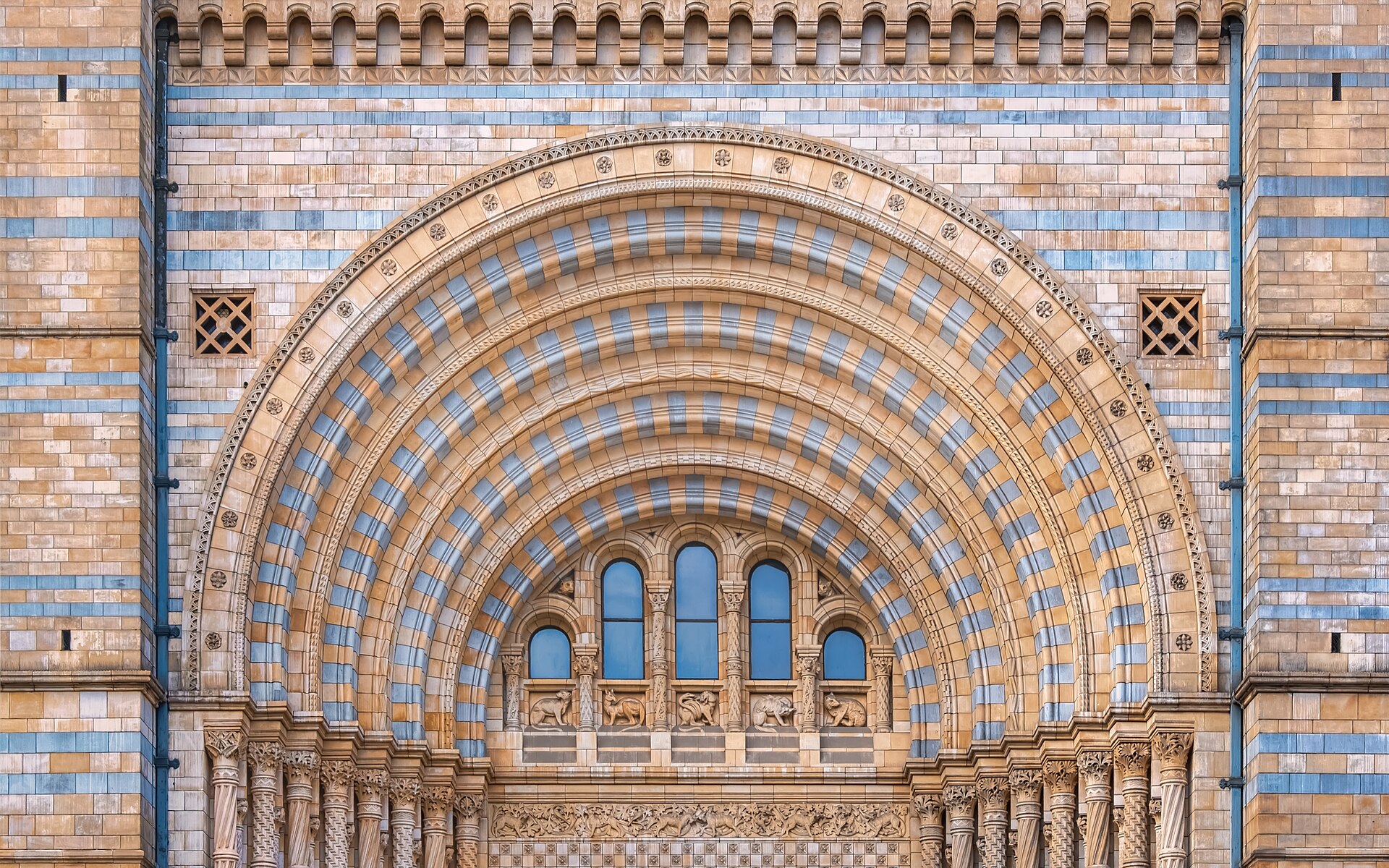
Alfred Waterhouse designed the Natural History Museum in the 1870s. Before anyone walked through the doors, he hid an argument in the stonework.
🏙️ Love London?
3,000 London lovers get hidden history, street-level stories, and local secrets every week. Free, forever — no spam, unsubscribe any time.
Subscribe free — enter your email:
On the eastern wing — the section dealing with living species — he carved animals that are still alive today into the terracotta facade. On the western wing, which covers ancient life and extinction, he carved fossils and prehistoric creatures instead.
Walk the full length of the building and you’re reading a theory about life on earth written in brick. Almost nobody notices.
Waterhouse also wanted the whole place to feel like a cathedral. The high arched entrance portal, the twin towers rising above the street, the long nave-like hall inside — none of that is accidental. He wanted visitors to feel awe before they’d seen a single exhibit.
The museum opened in 1881 as a branch of the British Museum. It became its own institution in 1963. It’s been free to enter since 1884 — a fact that has never changed, through two world wars and everything that came after.
80 Million Specimens — and Most Will Never Be Seen
The Natural History Museum holds over 80 million specimens. That number is almost impossible to process.
If you looked at one new object every single second, without stopping, without sleeping, it would take over 2,500 years to get through the whole collection. You’d start in Roman times and finish somewhere around the year 4500.
The collection spans 4.5 billion years of Earth’s history. There are moon rocks brought back by NASA. Pressed plants gathered by Charles Darwin on the voyage of the Beagle. Teeth from creatures that disappeared before humans existed.
Of all these objects, only a fraction are ever displayed in the public galleries. The rest are stored in climate-controlled drawers, shelves, and vaults. They’re research material — reference points for scientists from universities worldwide who travel specifically to study things the public will never see.
The museum’s curators describe it as scientific infrastructure rather than a display collection. It exists not to be looked at, but to be understood — slowly, carefully, over decades.
The Spirit Collection Nobody Talks About
Inside the Darwin Centre, there are 22 million specimens preserved in alcohol.
Jars of fish. Octopuses. Sea snakes. Beetles collected in the 1700s by naturalists who had no idea what they’d found. Some of those jars are older than the United States of America.
The Darwin Centre was built specifically to house this archive. It opened between 2002 and 2009, and for the first time gave ordinary visitors a chance to see where the real work of the museum actually happens.
You can book behind-the-scenes tours that take you past floor-to-ceiling shelves packed with specimens in their jars. Scientists work at benches nearby, entirely unbothered by visitors peering through the glass. The smell is sharp. The atmosphere is somewhere between a laboratory and a library.
It is one of the most genuinely strange places you can visit in London — and almost nobody knows it’s there.
The Secret Garden Behind the Western Wing
Most visitors walk straight past it.
The Wildlife Garden sits tucked behind the western wing of the museum, hidden from the main road. Step through the gate and you’re standing in a genuine piece of British countryside — wildflower meadows, a reed bed, a pond, hedgerows, and fruit trees in a space the size of a large back garden.
Butterflies and bumblebees work the flowers in summer. Hedgehogs have been recorded using it as a corridor through the city. On a warm afternoon in June, it’s one of the quietest spots in the whole of South Kensington.
The garden was created in 1995 to show children what lowland British countryside looked like before suburbs and tarmac covered most of it. It’s maintained without pesticides, and it genuinely works — real wildlife uses it, year after year.
If you enjoy finding quiet green corners in the city, London has more of them than most visitors realise. This ruined City of London church has another hidden garden that’s well worth knowing about.
What Hintze Hall Doesn’t Tell You About the Blue Whale
When you walk into the central hall — Hintze Hall — the first thing you see is a blue whale skeleton suspended from the ceiling.
Her name is Hope. She was placed there in 2017, replacing Dippy the Diplodocus who’d stood in the same spot for decades. Hope was a real animal. She died off the coast of County Wexford in Ireland in 1891, caught in a tidal inlet and found by local fishermen who had no idea what to do with her.
What the information panels don’t mention is that the museum’s scientists spent two full years studying her bones before the installation began. They found evidence of old injuries and growth patterns in her skeleton. She’s not just a showpiece. She’s a document — a record of decades of ocean life, read by people who know how to listen.
The Natural History Museum is one of the best free days out in London, especially for families visiting from abroad. The London with Kids guide covers everything you need to plan a full family trip to the city.
The Level Most Visitors Never Reach
The Natural History Museum has a mezzanine level above the main galleries. Almost nobody goes up there.
From the upper level, you look down directly onto the exhibitions below — and the whole scale of the place becomes real in a way it doesn’t from the ground. You can see Hope the whale from above, level with the curve of her ribcage. You can see the detail in the roof architecture that’s invisible when you’re standing beneath it.
There are smaller galleries up there too — gems and minerals, meteorites, a room of some of the oldest objects the museum owns — that most visitors never find because they follow the floor signs and stick to the main route.
The people who love the Natural History Museum have always ignored the signs. They walk in the wrong direction. They take the stairs when everyone else goes straight ahead. They follow whatever interests them rather than the arrows painted on the floor.
That’s been true since 1881. It still works.
If you’re planning your first trip to London, put the Natural History Museum on your list — and give it more than two hours. Most people need three, at minimum, just to scratch the surface.
And somewhere behind the walls, in their climate-controlled drawers and their spirit jars, the 80 million things you’ll never see are patiently waiting — holding the record of life on earth, ready for scientists who haven’t been born yet to come and understand them.
🇬🇧 25 Hidden Gems of London Most Tourists Never Find
From secret riverside walks to hidden Victorian tunnels, centuries-old pubs to rooftop gardens with skyline views — our free guide reveals the London most visitors never discover. Join 3,000+ London lovers who get it free.
Get Your Free London Hidden Gems Guide →Love more? Join 65,000 Ireland lovers → · Join 43,000 Scotland lovers → · Join 30,000 Italy lovers →
Free forever · Unsubscribe anytime