
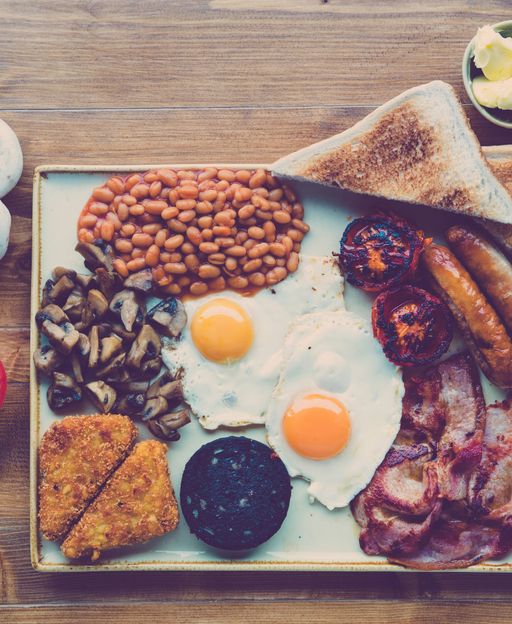
Ask ten Londoners what belongs on a “proper” plate and you will start an argument before the kettle boils: bacon and eggs are never in doubt, but the status of baked beans, black pudding, fried bread and the humble grilled tomato is debated with real feeling. Those beans, now treated as a birthright, only arrived when Heinz first sold baked beans in Britain as an imported luxury at Fortnum & Mason in 1886. This is Guide № 011 in The Love London Guide series.
Get the Full Collectible Guide (Free PDF)
The Full English Breakfast — in a beautifully designed, printable booklet. The Love London Guide № 011.
What Actually Goes on the Plate
A full English is built around back bacon and eggs (usually fried, sometimes scrambled or poached), with sausages, grilled or tinned tomatoes, mushrooms and baked beans filling out the plate. The supporting cast is where regional and personal taste takes over: black pudding (a sausage of pork blood, fat and oatmeal), fried bread or buttered toast, hash browns, and sometimes bubble and squeak made from the previous day’s potatoes and greens. Nothing is universally mandatory beyond the bacon and eggs, which is precisely why the plate starts so many friendly disputes.
The dish is frequently called a “fry-up,” though a good deal of it is in fact grilled, boiled or baked rather than fried. The English Breakfast Society keeps a running account of the meal’s components and history, and even it concedes there is no single definitive line-up — only a widely shared idea of what a full plate should feel like.
Where It Came From
The cooked breakfast as a cultural fixture is usually traced to the 19th century, when the country houses of the landed gentry set out a substantial morning spread for guests, and the growing Victorian middle class adopted the habit as a marker of a well-kept household. With industrialisation, a large hot breakfast became practical fuel for a long working day, and the meal spread well beyond the dining rooms where it began.
The 20th century gave it its most familiar home: the workers’ café, affectionately known as the “greasy spoon,” where a plate and a mug of strong tea could be had cheaply at any hour. That café tradition is what most visitors now picture, and it is still alive across London in independent cafés alongside polished hotel versions.
The Regional Cousins
The “English” in the name is doing real work, because each nation has its own version. A full Scottish typically adds a tattie (potato) scone, a flat square Lorne sausage and often haggis. A full Welsh brings laverbread — a purée made from cooked seaweed — and cockles. The Ulster fry leans on soda bread and potato bread and traditionally skips the beans altogether, while a full Irish often includes white pudding alongside the black. These are not garnishes on a theme; locals will tell you, correctly, that they are distinct meals.
The Sauce Question
The great condiment divide is between red and brown. Tomato ketchup is the crowd-pleaser, while brown sauce — most famously HP Sauce, named after the Houses of Parliament and now also made by Kraft Heinz — is the tangier, malt-vinegar-and-tamarind choice that purists reach for with bacon and sausage. There is no right answer, only strong opinions, and asking for both at once is a recognised act of diplomacy.
Where to Eat One in London
For the café experience, London still has independent cafés and small chains such as The Breakfast Club serving generous plates at a sensible price. At the grander end, the all-day café-restaurant The Wolseley on Piccadilly and the dining rooms of The Ritz London treat breakfast as an occasion. For a celebrated London twist on the morning fry, Dishoom serves a bacon naan roll that has become a landmark in its own right. If you want to plan a food-led visit more broadly, VisitBritain is a reliable starting point.
Myths Worth Retiring
Myth: Baked beans have always been part of it. In fact, beans are a relative latecomer, arriving as an imported American novelty in the late 1880s and only becoming a standard component in the 20th century.
Myth: It is called a “fry-up” because everything is fried. A good deal of a full English is grilled, poached, baked or boiled; the name is affectionate shorthand, not an instruction.
Myth: “The full monty” definitely comes from the breakfast. The phrase for “the whole lot” is commonly linked to a large breakfast said to be favoured by Field Marshal Montgomery, but the origin is disputed and unproven, so treat it as a good story rather than a settled fact.
Frequently Asked Questions
What is the difference between a full English and a fry-up?
In everyday use they mean the same thing — a large cooked breakfast of bacon, eggs and the usual accompaniments. “Full English” is the slightly more formal name, while “fry-up” is the casual term you will hear in cafés.
Do I have to eat the black pudding?
Not at all. Black pudding is a traditional and popular component, but it is perfectly normal to ask for it to be left off, and most cafés and restaurants will happily swap or drop items to suit you.
When is a full English actually served?
Many London cafés serve it from early morning, and plenty offer it “all day,” so you are rarely too late. Hotel breakfast service tends to run on fixed morning hours, so it is worth checking times if you are planning a sit-down meal somewhere grander.
More The Love London Guides
The Love London Guide is a numbered series — one tightly focused subject at a time, each with its own downloadable collectible edition. Guide № 001 is Fish and Chips, Guide № 002 is Trooping the Colour, Guide № 003 is The Red Telephone Box, Guide № 004 is English Breakfast Tea, Guide № 005 is The British Pub, Guide № 006 is The Great British Queue, Guide № 007 is London Dry Gin, Guide № 008 is Savile Row Tailoring, Guide № 009 is The Ravens of the Tower of London, Guide № 010 is British Sayings & Idioms, This is Guide № 011. More editions are on the way.
🇬🇧 Join 3,000+ London Lovers
Every week, get hidden stories, local secrets, and travel inspiration from people who live and love it.
Subscribe free — enter your email: