
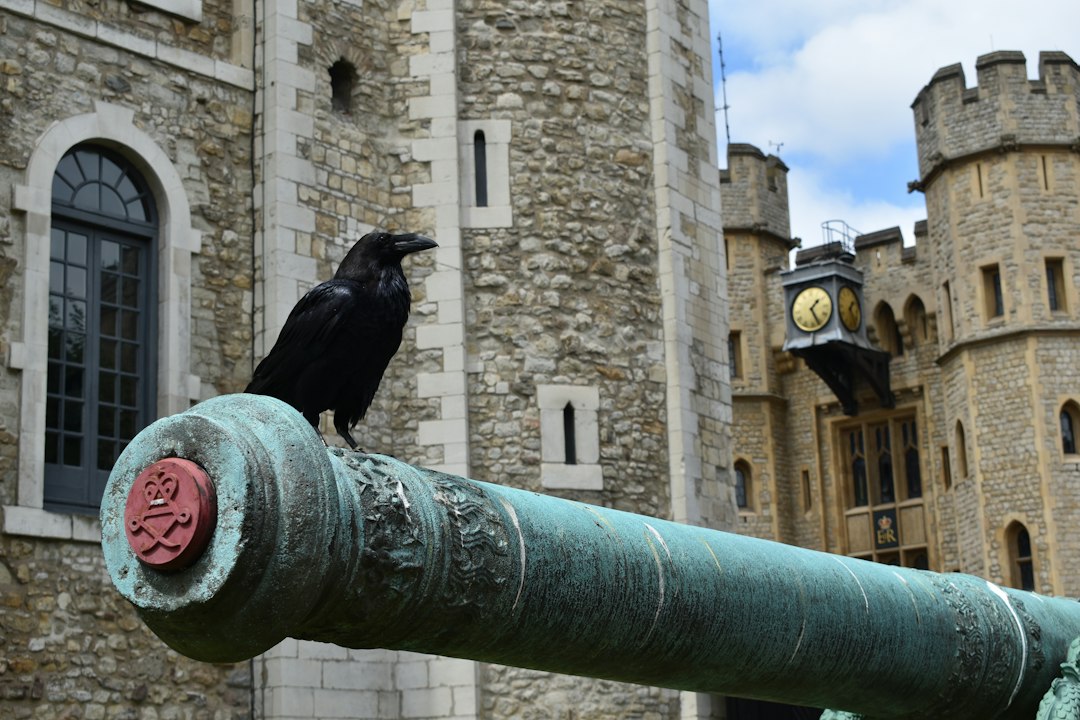
In 1986 a raven named George was formally dismissed from service at the Tower of London for “conduct unsatisfactory” — he had developed an appetite for television aerials on the houses across the moat. The detail is telling, because the Tower’s ravens are not merely resident birds but enlisted ones, each kept on the strength like a soldier and capable, in principle, of being discharged. This is Guide № 009 in The Love London Guide series.
Get the Full Collectible Guide (Free PDF)
The Ravens of the Tower of London — in a beautifully designed, printable booklet. The Love London Guide № 009.
The Legend That Keeps Them Here
The story most visitors arrive knowing is a grave one: should the ravens ever leave the Tower of London, the White Tower will crumble and a great disaster will befall the kingdom. It is a wonderful piece of belief, and it is the reason a minimum of six birds is kept on site at all times, cared for at the Crown’s expense by the charity Historic Royal Palaces. What very few people are told is how recent the legend appears to be. Despite its royal trappings, no documentary evidence of ravens living at the Tower has been found earlier than the 1880s, and historians who have combed the records suspect the whole tradition is Victorian in origin rather than medieval.
A popular version credits King Charles II with founding the custom in the 1670s. As the tale goes, the king’s astronomer complained that ravens were fouling his observations, Charles ordered the birds destroyed, and then — warned that their loss would doom the realm — he reversed himself, decreed that six should always remain, and moved his star-gazing to Greenwich instead. It is a splendid origin story, and almost certainly an embellishment stitched together long after the fact.
The Astronomer and the Greenwich Connection
The astronomer in that legend was John Flamsteed, the first Astronomer Royal and a Fellow of The Royal Society, who began his work in a turret of the White Tower before the Royal Observatory Greenwich was built for him in 1675. The move to Greenwich did happen, and ravens were common scavengers across London in that period, so the raw ingredients of the story are real. What is missing is any contemporary record of the royal decree itself.
Meet the Ravenmaster
Day-to-day care falls to the Ravenmaster, a serving Yeoman Warder — one of the red-and-gold-uniformed figures popularly called Beefeaters — who holds the post alongside his or her other duties. The role involves a genuine bond with the birds: they are called by name, fed by hand, settled into their enclosure each night and let out each morning. Christopher Skaife, who has held the post in recent years, wrote a widely read account of the work that peeled back much of the romance to show the practical, early-rising reality of tending some of the most intelligent birds in Britain.
The ravens are fed a diet of raw meat and bird biscuit soaked in blood, supplemented with the occasional egg, mouse or rabbit. They sleep in a purpose-built enclosure beside the Wakefield Tower, opened in 2015, which replaced older cages and gives them far more room. Crucially, the birds are not caged by day — they roam the grounds, strut across the lawns, and are perfectly capable of taking visitors’ snacks if given the chance.
How You Stop a Bird From Leaving
If the kingdom’s fate rests on the ravens staying put, the practical question is how. The answer is that the flight feathers on one wing are trimmed, which unbalances the bird enough to prevent sustained flight while leaving it able to hop, glide and move about freely. It does not clip their spirit, and it is not foolproof — ravens have absconded before. Raven Grog was last seen in 1981 reportedly outside a pub in the East End, and others have simply flown off over the years, which is one reason a seventh bird is usually kept in reserve.
The ravens of the Tower are common ravens, Corvus corax, the largest member of the crow family and a species the RSPB notes for its remarkable intelligence and its ability to mimic sounds, including human speech. Wild ravens rarely live beyond ten to fifteen years, but under protected conditions the Tower’s birds can last far longer; one nineteenth-century raven, Jim Crow, is traditionally said to have reached the age of forty-four.
War, Loss and Royal Patronage
The ravens’ modern status owes much to the Second World War, during which the population at the Tower collapsed and, by some accounts, only a single bird survived the Blitz. It is widely said that Winston Churchill personally insisted the ravens be restored to a full complement afterwards, treating them as a matter of national morale. As with much of the raven lore, the Churchill detail is repeated more confidently than the archives strictly support, but the Tower was indeed restocked after the war and the tradition has been maintained with care ever since.
Myths Worth Retiring
Myth: Charles II founded the raven tradition in the 1670s. There is no contemporary record of ravens being kept at the Tower before the late nineteenth century, and the custom is most likely Victorian. The royal origin story is a later addition.
Myth: The ravens cannot fly at all. Their feathers are trimmed on one wing to unbalance flight, not to ground them completely. They can still move with surprising agility, and a few have escaped entirely.
Myth: There are always exactly six ravens. Six is the traditional minimum, but the Tower normally keeps a seventh as a spare, and numbers have risen higher when chicks have been successfully reared on site.
Frequently Asked Questions
Can you actually see the ravens when you visit?
Yes. The birds roam the grounds during opening hours and are most often seen around the South Lawn and near the Wakefield Tower. Your admission to the Tower of London includes them at no extra charge, and general visitor information for planning a trip is available through Visit London.
How many ravens live at the Tower?
At least six by tradition, usually with a seventh kept in reserve. The exact total shifts over time as birds die, retire or, occasionally, are born at the Tower.
Do the ravens have names?
They do, and each is known individually to the Ravenmaster. Names over the years have included Jubilee, Harris, Gripp, Rocket, Erin, Poppy and Merlina, the last of whom became something of a favourite before her disappearance in 2021.
More The Love London Guides
The Love London Guide is a numbered series — one tightly focused subject at a time, each with its own downloadable collectible edition. Guide № 001 is Fish and Chips, Guide № 002 is Trooping the Colour, Guide № 003 is The Red Telephone Box, Guide № 004 is English Breakfast Tea, Guide № 005 is The British Pub, Guide № 006 is The Great British Queue, Guide № 007 is London Dry Gin, Guide № 008 is Savile Row Tailoring, This is Guide № 009. More editions are on the way.
🇬🇧 Join 3,000+ London Lovers
Every week, get hidden stories, local secrets, and travel inspiration from people who live and love it.
Subscribe free — enter your email: