
In the summer of 1780, a mob several thousand strong marched across Hampstead Heath with one goal in mind: to burn down Kenwood House and destroy everything inside it. The great manor on the hill was home to Lord Mansfield, a judge they despised. And they were coming from the south, which meant they had to pass a white-painted pub on Spaniards Road.
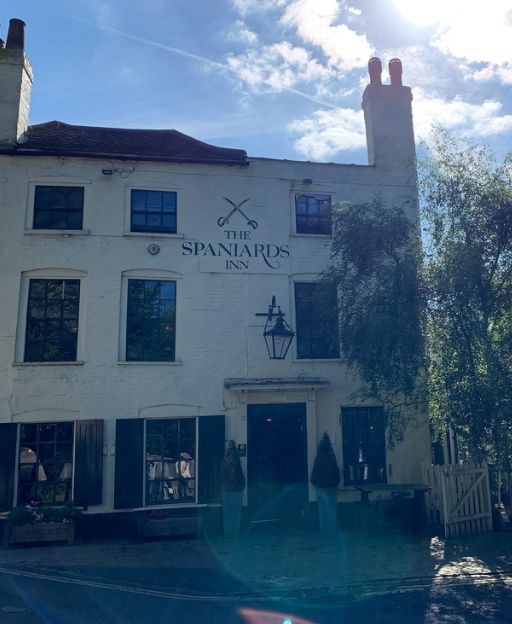
The landlord of the Spaniards Inn made a decision that night. He opened his doors. He sent out rounds of free beer. And then he kept sending them.
By the time the mob sobered up enough to remember why they were there, the troops had arrived. Kenwood House was saved. Its art collection — which today includes a Rembrandt, a Vermeer, and a Gainsborough — remained intact. And a small pub between Hampstead and Highgate quietly returned to business.
One Night That Secured the Pub’s Place in History
The Gordon Riots of June 1780 were the most violent civil unrest London had seen in a century. They started as a Protestant march against Catholic Relief legislation but quickly turned into something far uglier — a wave of burning, looting, and destruction that left hundreds dead.
Lord Mansfield, one of Britain’s most senior judges, was a target. Rioters had already burned his London townhouse on Bloomsbury Square and destroyed his library and papers. Kenwood House was next.
The landlord’s tactic was simple. Offer the crowd free beer. Keep them talking, singing, and drinking. Send a rider to fetch the troops. And wait.
It worked. The soldiers arrived before the mob could get moving again. No torches were thrown. The house stood. The paintings survived.
That story has been told around the Spaniards’ fireside ever since. It is the kind of thing you learn if you stop here long enough — which, at a pub this old, feels like exactly the right approach.
Four Hundred Years of Famous Visitors
The Spaniards Inn dates to around the 1580s, though the exact origins are disputed. One story holds that it was built as the home of the Spanish ambassador to the court of James I. Another claims the name comes from two Spanish brothers who owned it and ended up killing each other in a duel over a woman. Neither can be verified. Both are entirely plausible for a pub this old.
What is well documented is the list of people who have drunk here. Charles Dickens was a regular. He name-checks the Spaniards in The Pickwick Papers, where Mrs Bardell and her friends enjoy a tea party in the garden. John Keats wrote part of Ode to a Nightingale nearby, on Hampstead Heath, and the pub was well within his walking radius. Joshua Reynolds, the portrait painter, is said to have been a habitué. Lord Byron came here. Even Bram Stoker is connected — some scholars believe scenes in Dracula were inspired by this stretch of Hampstead.
Then there is Dick Turpin, the highwayman. According to local legend, Turpin used the Spaniards as a base when he worked the Great North Road, which ran close by. The pub still has a stable where his horse Black Bess was allegedly kept. It is impossible to verify. It is entirely the sort of thing that makes the place feel extraordinary.
The Narrow Road That Has Never Changed
There is something unusual about the road directly outside the Spaniards Inn. It narrows to a single lane, with the pub on one side and a small toll house on the other. Traffic has to take turns.
That toll house dates to the 18th century, when travellers crossing Hampstead Heath were charged a fee to pass. The Spaniards was effectively the gatehouse pub — the place where coachmen waited while the toll was collected, and where they stayed to drink while their horses rested.
The narrow road remains because the buildings on either side are listed. No one can widen it. The result is a pinch point on the B519 that causes no end of traffic frustration — and gives the pub an atmosphere that money cannot manufacture.
Sit in the garden on a summer evening, listen to the cars queuing in single file, and you are not far from how this corner of London felt two hundred years ago.
What a London Pub Actually Is
The Spaniards Inn is a good place to understand why London pubs are not simply bars. They are not restaurants. They are not clubs. They are something older and stranger than either.
A London pub operates on an unwritten set of social rules. You go to the bar to order — there is no table service in the traditional sense, though many pubs now offer it. You do not save a table by leaving a coat. You do not rush. You make conversation if the person next to you makes eye contact. You do not make conversation if they are staring into their pint.
A Sunday roast at a pub is a ritual, not just a meal. It happens between noon and four. There is a Yorkshire pudding. There is gravy. The beef is usually overcooked and is always satisfying. Families spread across the tables, glasses of wine appear, and nobody is in a hurry to leave.
The Spaniards does this well. Its garden, rambling over a large terrace behind the building, fills up fast on weekends. People walk over from the Heath with dogs and children and settle in for the afternoon. It is one of the most London afternoons you can have without spending very much money.
If you are planning a trip and want to understand what makes this city feel like itself, a long afternoon at a good old pub is at least as instructive as any museum. You can read more about the layers of London history hidden in plain sight across the city — many of them, like the Spaniards, are completely free to visit.
How to Visit the Spaniards Inn
The Spaniards Inn sits on Spaniards Road, NW3 7JJ, on the northern edge of Hampstead Heath. The nearest tube is Hampstead on the Northern line, about a twenty-minute walk across the Heath. Alternatively, the 210 bus stops almost at the door.
The pub opens at noon seven days a week. Dogs are welcome in the garden and in parts of the bar. Food is served daily. The Sunday roast is popular and worth booking ahead.
If you time it right, you can walk across Hampstead Heath from the tube, stop for a pint in the Spaniards garden, and then continue down to Kenwood House to see the art collection that the landlord’s quick thinking helped to save. The Rembrandt is there. The Vermeer is there. The walk from the pub to the house takes about ten minutes.
That is a very good afternoon. It costs almost nothing. And it connects you directly to a story that most visitors never hear.
For everything you need before your trip — from what to see to where to go — our free guide to London’s hidden gems is a good place to start. And if you’re still working out the best time to visit London, summer evenings at a pub garden like this one are hard to beat.
Join 3,000+ London Lovers
Every weekday morning, get London’s hidden gems, culture, and travel inspiration — straight to your inbox.
Subscribe free — enter your email:
Love more? Join 65,000 Ireland lovers → · Join 43,000 Scotland lovers → · Join 30,000 Italy lovers →
Free forever · Unsubscribe anytime
London has a thousand versions of this story. A place that looks ordinary from the outside, that turns out to have saved something remarkable. The Spaniards Inn is just one of them — but it is one of the best places to sit, drink, and let the city wash over you.