
Somerset House stands on the Strand, a few minutes’ walk from Covent Garden and Temple. Today it holds galleries, a courtyard and a busy events programme. Its past is far older and far stranger. A Tudor lord began it as a palace, queens lived in it, and for more than a century the government used it to count the nation’s births, marriages and deaths. If you have English roots, this building may already hold a page of your family story.
A Lord Protector builds a palace on the Strand
The story starts in 1547. Henry VIII had just died, and his son Edward VI was only nine years old. Edward Seymour, Duke of Somerset, took charge of the country as Lord Protector. He wanted a home to match his new rank, so he chose a long riverside plot on the Strand.
To clear the ground, Seymour pulled down several medieval town houses that belonged to bishops, along with a church. He then built a Renaissance-style palace, one of the first in London to copy the classical designs coming from Italy. Craftsmen worked fast, but Seymour never finished the job. His rivals brought him down, and he went to the block on Tower Hill in January 1552.
The unfinished palace passed to the Crown. It kept the name Somerset House, and the name has stayed ever since. For readers who enjoy Tudor history, our guides to Hampton Court Palace and Buckingham Palace show how other great houses in the capital changed hands.
🏛️ Free Guide: How to Trace Your English & British Ancestry
Step-by-step: GRO records, census 1841–1921, parish registers, the National Archives (Kew), London Metropolitan Archives, and planning a heritage trip. Completely free.
Get the Free Guide → Subscribe free at the guide page to receive weekly London heritage storiesQueens, a chapel and a royal household
From the early 1600s the house became a home for royal women. Anne of Denmark, wife of James I, took it over and rebuilt parts of it. In 1617 the house was renamed Denmark House in her honour. She employed the great architect Inigo Jones, who worked on the site.
Later queens followed. Inigo Jones designed a chapel here for Henrietta Maria, wife of Charles I. Catherine of Braganza, the Portuguese wife of Charles II, ran a household in the house as well. These queens gave the old palace a quiet, court-in-miniature feel, set well away from the bustle of Whitehall.
By the 1700s the royal family had lost interest. The buildings grew shabby, and parts were let out to officials and to the Royal Academy of Arts. By 1775 the old palace was tired and expensive to keep.
25 London places most visitors miss
Riverside walks, City courtyards, centuries-old pubs and rooftop gardens, each with a map link, in one free printable guide. Enter your email and we will send it.
Sir William Chambers rebuilds it for the state
In 1775 an Act of Parliament cleared the way to pull the old palace down and build something new. The Crown chose the architect Sir William Chambers, who also designed the pagoda at Kew. His brief was practical: build offices for the growing machinery of government, plus rooms for learned societies.
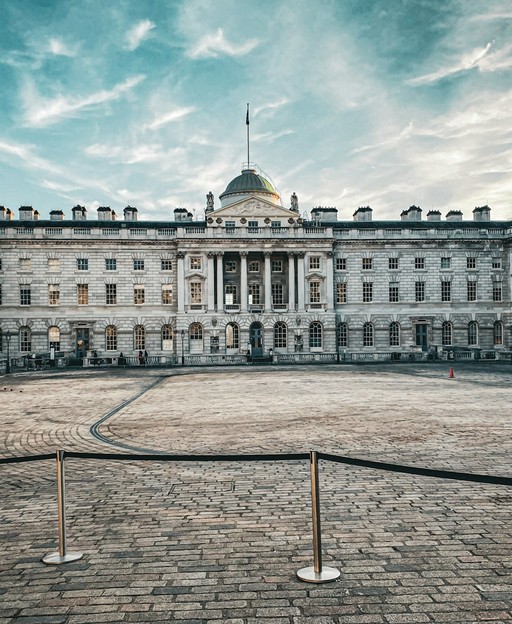
Chambers designed a grand Georgian block of pale Portland stone around a large courtyard. Work began in 1776, and it carried on into the early 1800s, with later architects adding the east and west wings. The Strand front gave the building a handsome face to the street, with a central pavilion and a dome that you can see in our photograph.
The new Somerset House housed the Royal Academy of Arts, the Royal Society and the Society of Antiquaries. It also housed the Navy Board, which ran the Royal Navy’s ships and dockyards. Sailors, clerks and scholars all passed through the same arches.
There is one more detail that surprises visitors. When Chambers built it, the river Thames ran right up to the south side of the building. Boats pulled up to water gates beneath the terrace. In the 1860s the engineer Joseph Bazalgette built the Victoria Embankment, which opened in 1870. It pushed the river back and left Somerset House standing well inland, where it stands today.
Chambers worked on the building for the rest of his life, and he died in 1796 before it was complete. His plan shaped everything that followed. The long Strand front, the arched ground floor and the sweep of the courtyard all come from his drawings. He wanted the building to look like a public statement: orderly, calm and built to last.
The size of the project reflects the age. Britain was building a large navy and a larger civil service, and both needed space. Somerset House gave clerks, accountants and naval officers a single address in the heart of London. It was an early example of a purpose-built government complex, and it set a pattern that other European capitals copied.
The place where Britain kept its family records
Somerset House has a second claim to fame, and American visitors with English ancestors should hear it. In 1837 England and Wales began to register every birth, marriage and death. The General Register Office set up its home at Somerset House, and its huge index volumes sat on the shelves there for well over a century. Wills and probate records were also kept in the building for many years.
Family historians in the Victorian age and long after queued here to search the red and black ledgers by hand. Many used the phrase “a certificate from Somerset House” for generations. The records have since moved away from the building, and you can now order certificates online from the General Register Office. For older records, such as parish registers and wills, the National Archives is the best place to start. Both sites were checked in November 2026.
What you can see today
Government offices left the building in stages through the late twentieth century. For years the courtyard served as a car park for office workers. Then the building opened to the public as an arts and culture centre, and the courtyard became one of London’s best open spaces.
The Courtauld, a gallery and art institute, has had its home in the Strand block since 1989. You can read about its collections on the Courtauld website. The wider site runs exhibitions, concerts and seasonal events. Because programmes and opening arrangements change, check the official Somerset House website before you go. We checked it in November 2026, and we recommend you do the same.
Here are three simple tips for your visit:
- Stand in the middle of the courtyard and look back at the Strand block. The dome and columns show Chambers’s plan at its clearest.
- Walk through the arches to the river side. This is where the Thames once met the building, before Bazalgette’s Embankment.
- Look for the carved keystones and nautical details on the stonework. They echo the building’s old links to the Navy and the Crown.
Somerset House pairs well with a walk along the river. If you enjoy buildings that changed shape after disaster, read about the 1834 fire at the Palace of Westminster and the Great Fire of London, which swept through the City not far east of here.
Why Somerset House matters
This one building holds Tudor ambition, royal family life, Georgian design, naval power and the roots of modern family history. It rewards a slow visit. Stand in the courtyard, picture the Thames lapping at the arches, and think of the clerks who once wrote down your ancestors’ names.
Quick answers for visitors
Who built Somerset House?
Edward Seymour, Duke of Somerset, began the first palace in 1547. Sir William Chambers designed the Georgian building you see today, and work started in 1776.
Why do family historians know the name Somerset House?
England and Wales began civil registration of births, marriages and deaths in 1837, and the General Register Office kept its records at Somerset House for generations.
Where is Somerset House?
It sits on the Strand in central London, a short walk from Covent Garden and Temple. Check the official website for current opening arrangements before you visit.