
Every day, thousands of visitors crowd around the railings outside Buckingham Palace waiting for something they can barely see. An hour later, many leave feeling vaguely let down — unsure what they missed or why. The Changing of the Guard is one of London’s most recognisable ceremonies, and one of its most misunderstood.
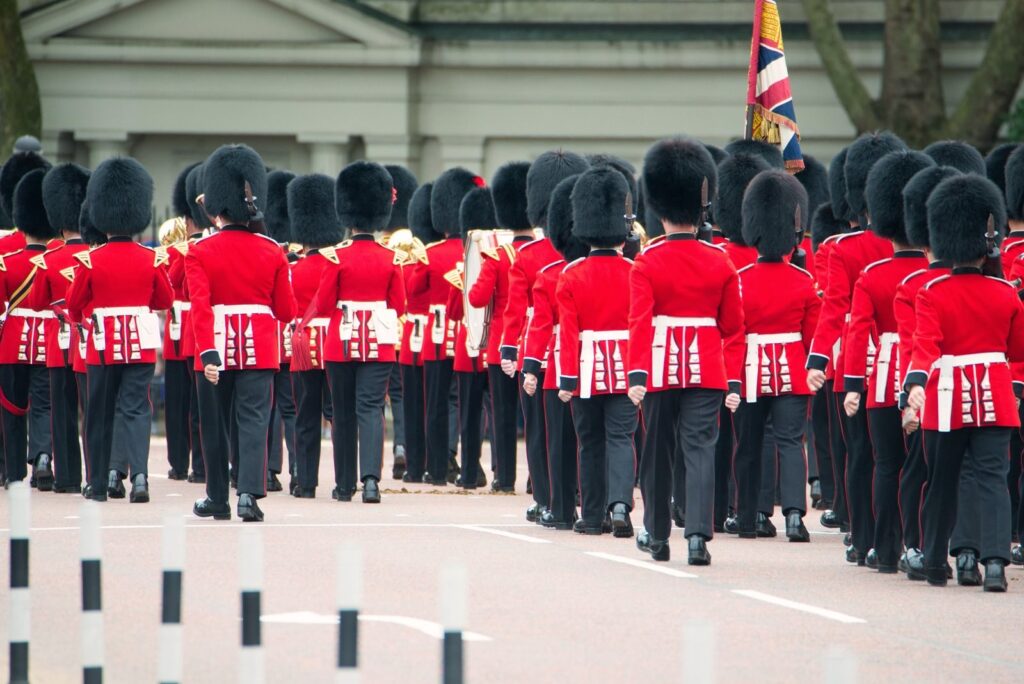
It’s Actually Two Ceremonies, Not One
Most people think of the Changing of the Guard as a Buckingham Palace event. It is — but that’s only part of the picture.
The ceremony begins at Wellington Barracks, a short walk from the palace, where the New Guard forms up and marches with a band. At Buckingham Palace, the New Guard relieves the Old Guard in the forecourt. But at the same time, a separate detachment heads to St James’s Palace, half a mile up the Mall, where another handover takes place at the gatehouse.
The St James’s detachment is the better viewing experience by a considerable margin. The crowd is a fraction of the size, the gatehouse is right at street level, and the guards rotate and stamp in the archway just metres in front of you. Almost no travel guide mentions this. Go to St James’s.
If you’re building a full first visit around this and other royal sights, our 5-day London itinerary for first-time visitors covers the timing and logistics in detail.
How to Read the Guards’ Uniforms
Five Foot Guard regiments take turns on Queen’s Guard duty, and each has its own markings. Once you know what to look for, you’ll never confuse them again.
The Grenadier Guards wear a white plume on the left of their bearskin, with evenly spaced buttons on the tunic. The Coldstream Guards have a red plume on the right, with buttons in pairs. The Scots Guards have no plume at all and buttons in groups of three. The Irish Guards wear a blue plume on the right, buttons in fours. The Welsh Guards have a green and white plume on the left, buttons in fives.
The bearskin caps — they’re not called “hats” — weigh around 700 grams each and have been worn since the Battle of Waterloo in 1815. They’re made from Canadian black bear fur, chosen because it’s naturally water-resistant and maintains its shape under pressure. They do not stop bullets. They never did. They were a psychological weapon: making soldiers appear taller and more imposing on the battlefield.
Each regiment has centuries of history behind it. The Grenadiers have guarded the monarch since 1656. You can trace much of that royal history through objects still on display in London — including the ancient coronation throne that has seated every British monarch since 1308.
The Best Time to Arrive — and What You’re Actually Watching
The ceremony runs at 11:00am most days. The full handover takes around 45 minutes.
If you’re watching at Buckingham Palace, arrive by 10:15am to secure a spot near the centre gates, where you can look into the forecourt. Later arrivals find themselves three or four rows back, seeing mostly other people’s heads and raised phones.
At St James’s Palace, 10:30am is usually enough. Stand on the south side of the gatehouse for the best angle as the guards rotate in the archway.
What you’re watching is the transfer of the Queen’s Colour — a ceremonial flag — from the Old Guard to the New Guard. The band plays throughout: marching music on the way in, ceremonial tunes during the handover, and often a well-known popular piece as they return to barracks. In recent years, the bands have played themes from James Bond, Star Wars, and Abba. The choice is made by the bandmaster and changes regularly. It’s a small, human touch in an otherwise ancient ceremony.
When the Ceremony Doesn’t Happen
The ceremony runs daily from late March to late July. For the rest of the year, it takes place on alternate days only. Check the official Household Division schedule before visiting — this catches out a surprising number of visitors.
It can also be cancelled entirely without advance notice. Heavy rain will cancel a ceremony, as prolonged wet weather damages the bearskin caps and dress uniforms. State occasions, funerals, and certain royal events also take precedence. A last-minute cancellation means a small notice at the gate and nothing else.
There’s no official announcement on the day, no email, no app alert. Turn up without checking and you might find an empty forecourt and a confused crowd wondering what happened. Always check the night before.
The History Behind the Ceremony
The practice of posting armed sentries outside the royal palaces dates to the 17th century, when the monarchy needed genuine physical protection. The elaborate ceremonial form — full dress uniforms, a marching band, the precise choreography of the handover — developed gradually through the 18th and 19th centuries as the threat receded and the ritual took on a different purpose.
During the Second World War, the ceremony was scaled back as regiments were deployed overseas. When it returned to its full form after 1945, it carried symbolic weight. The uniforms, the music, the precision — all of it communicated that something important had survived the war intact.
The soldiers you see are not purely ceremonial figures. Every guardsman has completed standard British Army infantry training and many have served on active deployments. The scarlet tunic and bearskin come off at the barracks. The person inside is a working soldier.
For everything else you need to plan your London visit, our London travel planning hub is the best place to start.
Frequently Asked Questions
What time does the Changing of the Guard start in London?
The ceremony begins at 11:00am at Buckingham Palace. Arrive by 10:15am for a clear view from the front rows. The full handover takes approximately 45 minutes.
Is it free to watch the Changing of the Guard?
Yes, completely free. You watch from the public pavement outside Buckingham Palace or from the street in front of St James’s Palace. No tickets, no booking, no queuing system.
What is the best place to watch the Changing of the Guard in London?
St James’s Palace on the Mall gives a far closer and less crowded view than Buckingham Palace. The guards rotate in the gatehouse archway just metres from the pavement. Most visitors don’t know this viewpoint exists.
Does the Changing of the Guard happen every day?
Daily from late March to late July, then on alternate days the rest of the year. It can be cancelled at short notice due to heavy rain or state events. Always check the Household Division schedule the evening before your visit.
The ceremony has run, in one form or another, for nearly 400 years. Most of what makes it remarkable happens quietly — in the details of a plume, the weight of a cap, the discipline of a soldier who has marched this exact route hundreds of times. Worth knowing before you go.
🇬🇧 25 London Places Most Visitors Miss
From secret riverside walks to hidden Victorian tunnels, centuries-old pubs to rooftop gardens with skyline views — our free guide reveals the London most visitors never discover. Join 3,000+ London lovers who get it free.
Get Your Free 25-Places Guide →Free forever · Unsubscribe anytime
Subscribe Free