
Most people have never heard of Eel Pie Island. It sits in the middle of the Thames at Twickenham, barely big enough to fill two football pitches. You can only reach it via a small footbridge. But for about fifteen years in the middle of the twentieth century, this forgotten sliver of river island changed British music forever.
The Island That Got Its Name From a Pie
Victorian Londoners loved a day out on the river. On sunny Sundays, Thames steamers carried thousands of day-trippers from the city out to Twickenham, Richmond, and Kingston. Eel Pie Island was one of the most popular stops along the route.
🏙️ Love London?
3,000 London lovers get hidden history, street-level stories, and local secrets every week. Free, forever — no spam, unsubscribe any time.
Subscribe free — enter your email:
The island’s hotel served a local speciality: eel pies. The Thames was full of eels in those days, caught straight from the riverbank by local fishermen. The dish was cheap, filling, and popular with working Londoners looking for a treat. Charles Dickens mentioned the island in Nicholas Nickleby in 1838, which tells you just how well known it was.
By the early 1900s, the Eel Pie Island Hotel had added a ballroom. Big bands played there through the 1940s and into the 1950s. Weekenders travelled up the river specifically to dance. The island had a slightly bohemian, easy-going spirit that felt different from the rest of London — a feeling that would shape everything that came next.
When Jazz Came Down the River
In 1956, a man named Arthur Chisnall began booking jazz acts into the hotel. He understood something important about the island: it felt genuinely separate from London. There were no police checks at the footbridge. The crowd was young, enthusiastic, and hungry for something new. Word spread quickly among musicians.
By the late 1950s, the Eel Pie Island Hotel had become one of the most important venues in London’s trad jazz scene. On a summer evening, the sound carried across the water. Audiences spilled out onto the grass between sets, watching the Thames move quietly past while the next act tuned up inside.
The atmosphere was electric and slightly ramshackle. The ceiling leaked when it rained. The stage was barely large enough for a full band. None of it mattered. The island had the kind of energy that can’t be manufactured — the kind that only happens when the right people end up in the right place at the right time.
The Night a Young Mick Jagger Took the Stage
In 1963, the Rolling Stones played Eel Pie Island for the first time. They charged three shillings at the door. The room held around 150 people. The stage was small, the acoustics were rough, and the beer was warm. Nobody cared.
The Stones played there regularly over the following two years. So did The Who, Rod Stewart, Eric Clapton, Long John Baldry, and Pink Floyd. The island had become the beating heart of the rhythm and blues movement that was about to reshape British culture entirely.
There was something particular about playing Eel Pie Island. Between sets, musicians would stand outside on the grass and listen to the Thames moving beneath them. The city felt a long way away, even though it was barely eight miles upstream. For young bands still finding their sound, that distance felt important. The island gave them room to breathe, to experiment, to be strange and loud without anyone telling them to keep it down.
If you want to understand where the sound of 1960s Britain came from, start here — a leaky ballroom on a small island in the Thames, where the entrance fee was less than the price of a pint.
The Fire and the Long Silence
By the late 1960s, the hotel had fallen badly into disrepair. The costs of keeping it running were too high, the roof was failing, and the crowds had moved on to newer venues in central London. The hotel closed its doors in 1967.
Squatters moved in and established a commune on the island. It attracted artists, writers, and musicians who couldn’t afford anywhere else. For a few years it had a strange, chaotic life of its own — a last echo of the free-spirited energy that had always made the island feel different.
In 1971, a fire broke out and gutted the building. The hotel that had launched so many extraordinary careers burned down in a single night. For a while, Eel Pie Island fell silent. The footbridge fell into disrepair. The island’s history was in real danger of being forgotten entirely.
What the Island Became
Today, Eel Pie Island is one of London’s strangest and most appealing places. About 50 people live there permanently, in houses that seem to grow organically from the riverbank. The island is home to roughly 30 artists and craftspeople — painters, sculptors, boat builders, potters, and glassmakers.
Access is via the same footbridge, though it now has a gate. The island is private — residents-only on most days. But once a year, usually in November, the island opens for a public arts weekend. Studios throw open their doors, residents show their work, and Londoners cross the narrow bridge to browse and explore. On that one weekend, the island briefly becomes what it has always been: a place slightly apart from the world, where different rules apply.
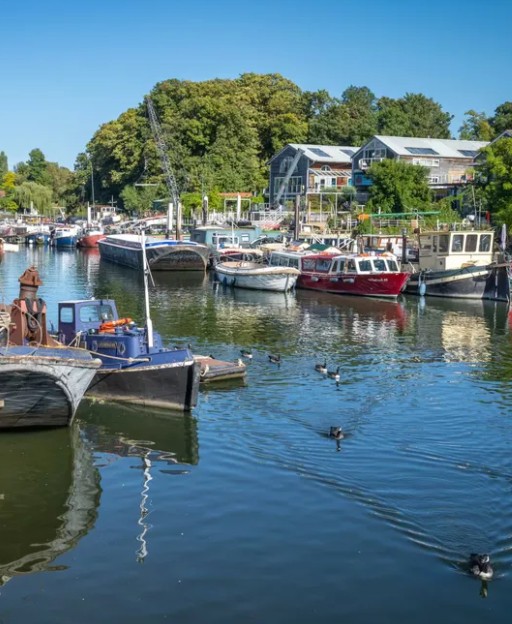
Even if you never go inside, you can stand on the Richmond Road bridge and look across at the island. Moored boats bob in the current. Willow trees trail their branches in the water. It looks exactly like a place where something extraordinary might have happened — which, of course, it did. The Thames has a habit of holding onto its history long after the rest of the city has moved on.
How to Get to Eel Pie Island
Eel Pie Island is at Twickenham, south-west London, about 40 minutes from Waterloo station by National Rail. Trains run regularly throughout the day and the journey takes you through some of London’s most attractive suburban stretches.
From Twickenham station, it’s a short walk to the riverfront. The footbridge is on the Twickenham side of the Thames, off Riverside. Even if the island itself is closed — which it usually is — you can walk along the river path and see the island clearly from the bank. The views across the water are particularly good in early morning or late afternoon, when the light catches the boats and the willows.
The surrounding area is well worth your time. Twickenham has several excellent riverside pubs and a genuine sense of place that central London rarely offers. Nearby Richmond is one of the most beautiful towns within London’s boundaries, with a deer park, a high street full of independent shops, and a hilltop view over the Thames valley that is genuinely spectacular.
If you’re travelling out to Twickenham, consider combining it with Richmond or Kew Gardens for a full day out. Our complete guide to getting around London covers the train lines, Oyster cards, and the best ways to reach places like this without a car.
If this is your first visit to London, the London planning hub will help you build a trip that mixes the famous landmarks with the places most visitors never find — the Thames islands, the hidden villages, the stories that London keeps quietly to itself.
Eel Pie Island never asked to be famous. It had a hotel, a footbridge, and a room where the music was good. That was enough to change everything. Today it sits in the river much as it always has — quiet, slightly apart from the world, holding its extraordinary history without making any fuss about it at all.
🇬🇧 25 Hidden Gems of London Most Tourists Never Find
From secret riverside walks to hidden Victorian tunnels, centuries-old pubs to rooftop gardens with skyline views — our free guide reveals the London most visitors never discover. Join 3,000+ London lovers who get it free.
Love more? Join 65,000 Ireland lovers → · Join 43,000 Scotland lovers → · Join 30,000 Italy lovers →
Free forever · Unsubscribe anytime