
The moment you step into Trafalgar Square, something happens before your brain quite catches up. The space is enormous — bigger than a football pitch — yet the buildings press in from all sides and the column towers above everything. You feel, despite yourself, quite small. That feeling was deliberately engineered.
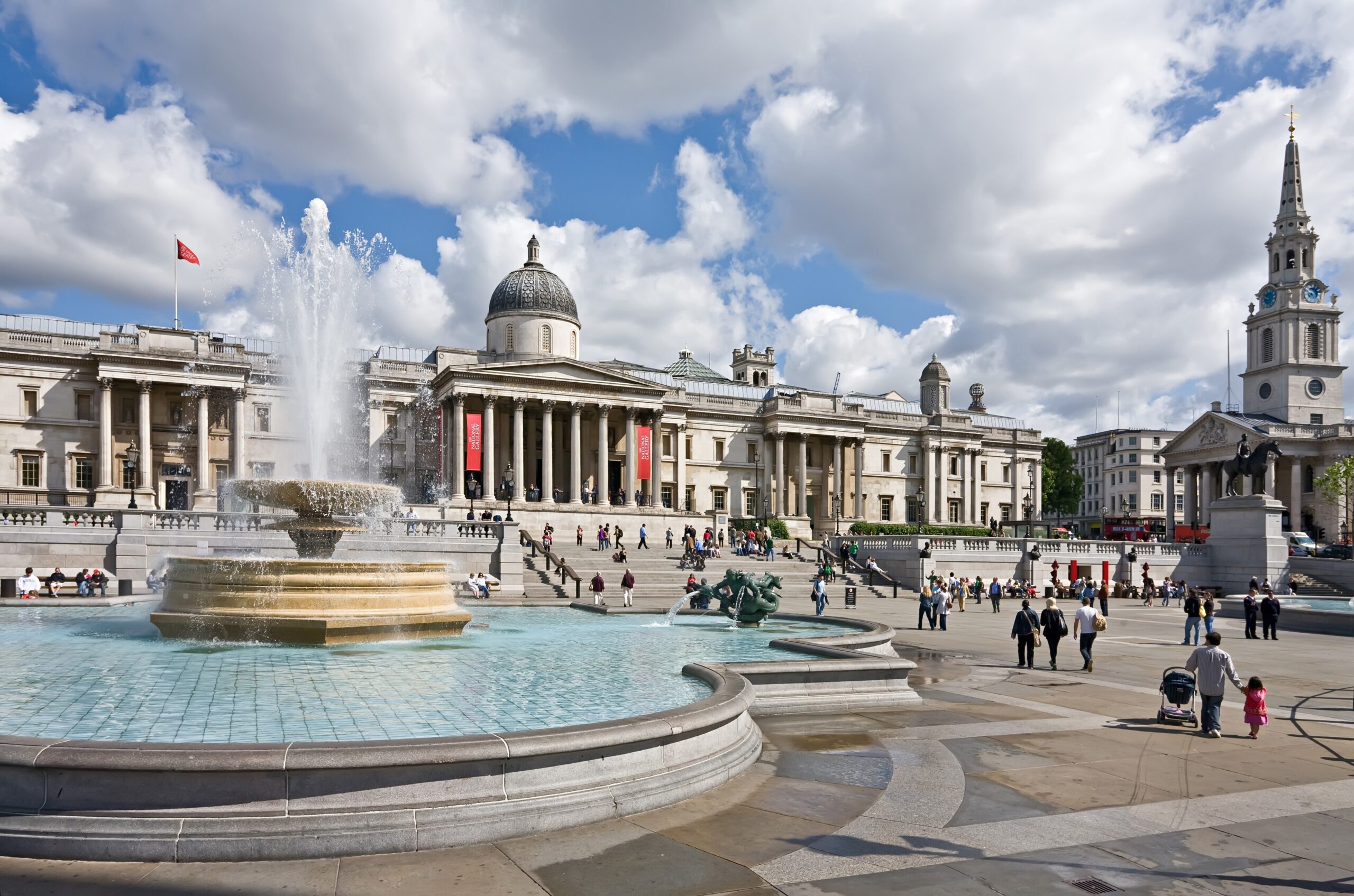
Trafalgar Square took decades to complete and has never stopped telling visitors exactly how they should feel about Britain. Here is the story it is actually telling.
The Battle That Changed Britain Forever
On 21 October 1805, Vice Admiral Horatio Nelson sailed toward a combined French and Spanish fleet off the coast of southern Spain, near a cape called Trafalgar. What followed was the decisive naval battle of the Napoleonic Wars.
🏙️ Love London?
3,000 London lovers get hidden history, street-level stories, and local secrets every week. Free, forever — no spam, unsubscribe any time.
Subscribe free — enter your email:
The British fleet of 27 ships faced 33 enemy vessels. Nelson’s tactic was bold to the point of recklessness — sailing his ships directly at the enemy line rather than approaching broadside. It worked. The French and Spanish fleet was destroyed. Napoleon’s plans to invade Britain died with it.
Nelson did not survive the victory. He was shot by a French sniper on the deck of HMS Victory and died three hours after the battle ended, having been told that the day was won. His body was preserved in brandy for the voyage home.
The significance was enormous. Britain would rule the seas unchallenged for the next century. A grateful nation immediately began arguing about how to commemorate it.
How a Royal Stable Became a National Square
The site of Trafalgar Square had previously housed the Royal Mews — the king’s stables — alongside an assortment of cramped streets and unremarkable buildings. In the 1820s, the old stables were cleared and architect John Nash began reshaping the area.
The square that emerged, designed largely by Charles Barry (who would later rebuild the Houses of Parliament), was completed in stages through the 1840s. It was intended to feel imperial: wide, open, and commanding. The National Gallery was built along the northern edge. The column rose in 1843.
The square was named after Trafalgar in 1830. Its proportions were calculated for effect — it is roughly three times the size of Parliament Square. That sense of scale pressing on your chest when you walk in is not imagination. It is architecture doing exactly what it was built to do.
A century and a half later, the same feeling hits every first-time visitor who wanders up from the Strand and suddenly finds themselves standing in that open space, looking up.
The Statue 51 Metres Up That Nobody Can Clearly See
Nelson’s statue sits at the very top of the column, 51.6 metres above the ground. From street level, you can barely make him out. He faces south-west — toward the sea, toward Trafalgar — with an empty eye socket and one arm missing, both lost in earlier battles.
There is something quietly remarkable about this. London built the most conspicuous monument it could conceive, then placed its hero at a height where no visitor could clearly see his face.
The column itself is made of Dartmoor granite. The statue is carved from Craigleith sandstone from Edinburgh. The bronze capital at the top — wider than most London rooms — was cast from cannons captured from enemy ships at Trafalgar.
Very few people who have stood in the square a hundred times could tell you any of this. That, too, is part of what makes the place quietly extraordinary: its grandeur is felt, not read.
The Lions That Arrived Thirty Years Late
The four lions at the base of the column are so central to Trafalgar Square that it is hard to imagine the place without them. But they were not part of the original design. They were added in 1867 — nearly a quarter century after the column itself was complete.
Edwin Landseer, best known as an animal painter, was given the commission years earlier but repeatedly delayed. He allegedly worked from a dead lion borrowed from London Zoo, studying the decaying carcass in his studio to get the anatomy right. Whether this accounts for the lions’ slightly cat-like quality — their paws positioned more like a large domestic animal than a true wild lion — has been debated ever since.
Whatever their anatomical origins, they became London immediately. Children climb them. Tourists photograph them. Protesters gather around them. The square without the lions is now unimaginable, which makes it stranger still to remember that they were an afterthought.
What the Fourth Plinth Says About London
In each corner of Trafalgar Square stands a plinth. Three carry statues: King George IV on horseback (looking uncomfortable, partly because the sculptor forgot to include stirrups), General Sir Charles Napier, and Major General Sir Henry Havelock. The fourth plinth, in the north-west corner, was intended for an equestrian statue of King William IV. Funding ran out.
The plinth sat empty for over 150 years. Since 1999, it has hosted rotating works of contemporary art commissioned by the Mayor of London. A blue cockerel. An enormous thumbs-up. A young Black man in a hoodie cast in bronze. Each installation generates argument — which is entirely the point.
The fourth plinth is now one of the liveliest public galleries in Britain, and it is completely free. If you are planning your time in London around its royal landmarks and open spaces, our London 3-day itinerary is a good place to start.
Where London Still Gathers
Trafalgar Square is not a museum piece. It is where London shows up when it matters.
New Year’s Eve brings enormous crowds. Political demonstrations fill its vast paving stones — it has been a site of protest and celebration since the 19th century. Each December, a Christmas tree goes up: a gift from Norway every year since 1947, a thank-you for the shelter Britain provided during the Second World War.
On any warm afternoon, people sit by the fountains with sandwiches and books. Pigeons, officially discouraged for years, have inevitably returned. The square belongs to everyone who stands in it.
For a deeper sense of how royal London connects around this part of the city, it is worth knowing what nobody tells you about watching the Changing of the Guard — which happens just ten minutes’ walk away. And for the full sweep of British royal history, the castle the Royal Family has called home for almost 1,000 years is within easy reach by train.
Nelson never saw the square that bears his battle’s name. He never stood where millions now stand and looked up at his own small stone figure against the London sky. But the city built something that outlasted the empire that created it — a square that still stops people mid-step, two hundred years on, and makes them feel the weight of everything that came before.
🇬🇧 25 Hidden Gems of London Most Tourists Never Find
From secret riverside walks to hidden Victorian tunnels, centuries-old pubs to rooftop gardens with skyline views — our free guide reveals the London most visitors never discover. Join 3,000+ London lovers who get it free.
Get Your Free London Hidden Gems Guide →Love more? Join 65,000 Ireland lovers → · Join 43,000 Scotland lovers → · Join 30,000 Italy lovers →
Free forever · Unsubscribe anytime