
There’s a cathedral standing right beside London Bridge. Millions of people walk past it every year — heading for Borough Market, the Tate, the Globe. Most never stop. Most never go in. That’s a genuine mistake.
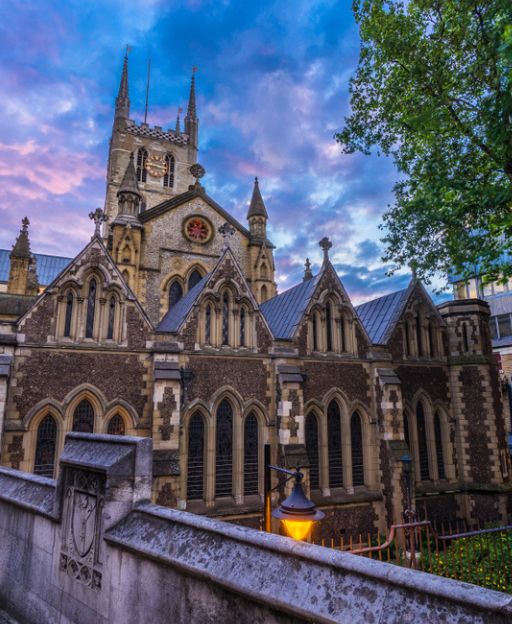
A Church Older Than the Bridge It Stands Beside
Southwark Cathedral didn’t start as a cathedral. For most of its history it was a priory church — the Church of St Mary Overie, meaning “over the water.” The name tells you something. This was the south bank of the Thames, outside the City of London proper, a place that existed apart from the wealth and order across the river.
A religious community has stood on this spot since at least the 7th century. The priory was founded in 1106. The Gothic building you see today took shape between the 12th and 16th centuries, with careful Victorian restoration in the 1800s. The oldest surviving section is the retrochoir — the space behind the main altar — which dates to around 1207.
Southwark only became a cathedral in 1905 when the Diocese of Southwark was created. Before that, it was simply one of London’s great parish churches. Which means for hundreds of years, it was just there, quietly holding the history of one of the most extraordinary stretches of the South Bank.
Pilgrims heading to Canterbury would stop here before crossing the bridge. Thomas Becket is said to have been educated nearby. The building has absorbed more of London’s story than most people walking past it could imagine.
The Shakespeare Connection Most Tourists Never Find
Shakespeare didn’t just work near this church. He lived in Southwark for years while writing plays at the Shakespeare’s Globe and other nearby theatres. He walked past this building regularly. He may well have worshipped here.
His younger brother, Edmund Shakespeare, was an actor. He followed William to London hoping for a stage career. Edmund died in December 1607, aged just 27. He was buried in the choir of this church — an expensive burial in a prestigious location. The records suggest his family paid for it. Most scholars believe William paid.
The cathedral today contains a memorial to Shakespeare himself — a reclining alabaster figure added in 1912, tucked into the south aisle. Above it, a stained glass window depicts characters from his plays: Hamlet, Falstaff, Prospero, Ophelia. It’s a quiet, thoughtful space. And unlike the tourist crowds at the Globe just minutes away, you’ll likely have it almost to yourself.
It’s one of the most intimate Shakespeare experiences in London. And it’s completely free.
Enjoying this? 3,000+ London lovers get stories like this every week. Subscribe free →
The Harvard Chapel Almost Nobody Knows
This is the part that tends to stop American visitors in their tracks.
John Harvard was born in Southwark in 1607. He was baptised right here — in this building. His family worshipped at St Saviour’s, as the cathedral was then known. As a young man, he emigrated to Massachusetts.
He died in 1638, aged just 30. But before he died, he left half his estate and his entire personal library — around 400 books — to a small college being established in Cambridge, Massachusetts. The college’s founders renamed it Harvard College in his honour.
That college is now Harvard University.
Inside Southwark Cathedral there is a Harvard Chapel, restored with funds from Harvard alumni in 1907 to mark the 300th anniversary of Harvard’s birth. A stained glass window tells the story of his life. The chapel is small, calm, and usually very quiet.
Thousands of people cross London Bridge every day with no idea it’s there, a few metres away.
John Gower — Where English Literature Begins
There’s one more connection that rewards anyone who loves books.
In the north aisle stands the elaborate painted tomb of John Gower, one of the greatest English poets of the 14th century. He was a contemporary and personal friend of Geoffrey Chaucer. His effigy lies with his head resting on three of his own major works — Vox Clamantis, Speculum Meditantis, and Confessio Amantis.
Gower and Chaucer helped shape the English language at a moment when it was still competing with French and Latin for dominance. Shakespeare knew Gower’s poetry well. He drew directly on the Confessio Amantis for the plot of Pericles. And in that play, Gower himself appears as a narrator and speaks the prologue.
Stand beside that tomb and you’re at a crossroads in English literary history: Chaucer’s friend, Shakespeare’s source, resting in a church where Shakespeare’s own family worshipped. The thread runs unbroken for more than 600 years.
What to See When You Visit
Entry is free. A voluntary donation is welcomed. Allow at least 45 minutes, more if you want to sit quietly and take the place in.
Start in the nave, then walk through to the choir where the medieval stonework becomes more intense. The retrochoir behind the high altar is particularly fine — early Gothic vaulting dating to the early 13th century. Find the Shakespeare memorial in the south aisle, then the Harvard Chapel just beyond. Gower’s tomb is in the north aisle, impossible to miss.
The cathedral has a small café and a shop worth browsing. On weekday afternoons, it often holds choral evensong — one of the finest free cultural experiences in South London.
The cathedral sits at the southern end of London Bridge, immediately beside Borough Market. The Tate Modern is a fifteen-minute walk west. Combine them on the same morning and you have one of London’s best days out.
If you’re still putting your trip together, the London trip planning guide covers everything you need before you arrive. The nearest Tube station is London Bridge, on the Jubilee and Northern lines. The cathedral is open daily, roughly 8am to 6pm.
Frequently Asked Questions
What is Southwark Cathedral best known for?
Southwark Cathedral is known for its direct connections to William Shakespeare — his brother Edmund is buried in the choir, and a Shakespeare memorial stands in the south aisle. It is also where John Harvard, whose bequest gave Harvard University its name, was baptised in 1607.
Is Southwark Cathedral free to visit?
Yes. Entry is free with a voluntary donation suggested. The cathedral is generally open daily from around 8am to 6pm. There may be entry charges for special events or exhibitions, so it is worth checking the schedule in advance.
How do I get to Southwark Cathedral from central London?
Take the Tube to London Bridge station, served by the Jubilee and Northern lines. The cathedral is about two minutes on foot from the station exit, at the southern end of London Bridge, immediately beside Borough Market.
What else is near Southwark Cathedral?
Borough Market is directly next door. The Shakespeare’s Globe Theatre is a ten-minute walk west along the riverside. The Tate Modern is around fifteen minutes on foot. The South Bank offers excellent walking between all three, with the river on one side throughout.
When is the best time to visit Southwark Cathedral?
Weekday mornings tend to be the quietest. If you want to experience choral evensong, check the cathedral’s schedule before visiting — it’s one of the most atmospheric free experiences in South London, and not widely known.
Most visitors to the South Bank walk straight past this building. They have the Globe on their list and Borough Market in mind and not enough time to stop. That’s understandable. But the cathedral has been standing here for over 800 years, quietly waiting. It can afford to be patient. The question is whether you can.
🇬🇧 25 Hidden Gems of London Most Tourists Never Find
From secret riverside walks to hidden Victorian tunnels, centuries-old pubs to rooftop gardens with skyline views — our free guide reveals the London most visitors never discover. Join 3,000+ London lovers who get it free.
Get Your Free London Hidden Gems Guide →📲 Know someone who’d love this? Share on WhatsApp →
Love more? Join 65,000 Ireland lovers → · Join 43,000 Scotland lovers → · Join 29,000+ Italy lovers →
Free forever · Unsubscribe anytime

Subscribe Free