
London is one of the great walking cities in the world. Its best neighbourhoods offer compact, walkable streets packed with independent shops and cafés, shifting in character every few hundred metres. If you’re visiting from the US, building neighbourhood walks into your itinerary — not just museum visits and attractions — is the difference between seeing London and experiencing it.
This guide covers eight of London’s best neighbourhoods to explore on foot in 2026 — from the candy-coloured terraces of Notting Hill to the creative energy of Shoreditch, the street food of Borough, and the calm grandeur of Mayfair. Each area has its own distinct character, and all are easy to reach by Tube or Overground from central London.
Notting Hill — London’s Most Photographed Streets
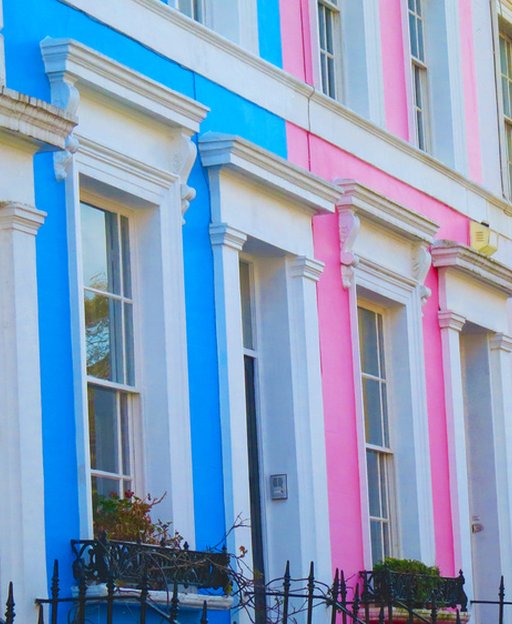
Notting Hill, in the Royal Borough of Kensington and Chelsea, is where the most photographed houses in London stand. The candy-pink, sky-blue, and sunshine-yellow Victorian terraces along Elgin Crescent, Blenheim Crescent, and the stretch of Portobello Road are exactly as striking in person as they look online — maybe more so on a sunny morning when the colours catch the light.
The neighbourhood centres on Portobello Road, which transforms into a full antiques and street market every Saturday. Even outside market days, the street’s independent shops, delis, and boutiques are worth an hour of wandering. The Electric Cinema on Portobello Road, opened in 1910, is one of the oldest working cinemas in Britain.
Arrive early on a Saturday to catch the antiques section at its best. By mid-morning the crowds are thick and the stalls sell out. Our full guide to Notting Hill covers everything you need for a full day in the area.
Best for: Photography, antiques, independent shops, the weekly market
Getting there: Notting Hill Gate (Central/District/Circle line)
Time needed: Half a day minimum; full day on a Saturday
Shoreditch and Spitalfields — East London’s Creative Heart
Shoreditch, in the London Borough of Hackney, is where London’s creative industries settled after the financial crisis of 2008. The area around Old Street, Hoxton Square, and Brick Lane is dense with independent restaurants, concept stores, street art, and music venues. It’s the part of London that changes fastest — a gallery or bar that was a fixture five years ago may now be a co-working space.
The walk from Shoreditch High Street station west along Bethnal Green Road and then south down Brick Lane takes you through the full character of the area. On Sundays, Brick Lane hosts a sprawling flea market selling everything from 1970s furniture to handmade ceramics. The Truman Brewery complex on Brick Lane houses additional indoor markets and an excellent coffee scene.
Spitalfields, just south of Shoreditch, adds another layer. Old Spitalfields Market — trading since 1638 — offers independent designers and artisan food traders under a Victorian roof. The surrounding streets of Fournier Street and Hanbury Street carry visible traces of the Huguenot Protestant refugees who settled here in the 1680s, the Jewish community of the late 19th century, and the Bangladeshi community that has shaped the area since the 1970s. Our piece on London’s Huguenot heritage tells the full story.
Best for: Street art, independent food, vintage shopping, east London culture
Getting there: Shoreditch High Street (Overground) or Liverpool Street (Central/Elizabeth line)
Time needed: Half a day; Sunday for the markets
Borough and Bermondsey — South London’s Food and Design Quarter
Borough, on the south side of London Bridge, is one of the most food-focused neighbourhoods in London. Borough Market — the city’s oldest and most celebrated food market — sits here, drawing the best artisan food producers in the country to sell direct to the public Wednesday through Saturday. Even outside market hours, the streets around Borough High Street and Stoney Street have an exceptional concentration of independent food shops and restaurants.
Walk south from Borough Market and you enter Bermondsey, a neighbourhood that shifted dramatically in character around 2010 when a wave of galleries, design studios, and restaurant openings followed the completion of the new Bermondsey Street developments. Today Bermondsey Street itself — lined with independent cafés, the Fashion and Textile Museum, and the White Cube gallery — is one of the most pleasant streets in south London for an afternoon walk.
The Bermondsey Antique Market on Bermondsey Square operates on Friday mornings from around 6am — dealers and collectors arrive in the dark to pick through silver, ceramics, and vintage textiles. This is a trade market as much as a public one, and it has a very different atmosphere from the tourist-facing markets elsewhere in London.
Best for: Food, galleries, independent design, the Friday antique market
Getting there: London Bridge (Jubilee/Northern line) or Bermondsey (Jubilee line)
Time needed: Half a day; combine with a Thames walk to Tower Bridge
Soho and Covent Garden — The Living Room of Central London
Soho, in the City of Westminster, is the neighbourhood that refuses to be gentrified into blandness. Despite decades of rising rents, it still holds a mix of independent restaurants representing nearly every cuisine in the world, live music venues, independent cinema, and some of the most interesting back streets in central London. Berwick Street Market, running along Berwick Street through the middle of Soho, has sold fruit and vegetables here since the 18th century.
Covent Garden, immediately east of Soho, is a different energy — more tourist-friendly, centred on the Victorian covered market building in the piazza. The Apple Market inside the piazza sells handmade jewellery, artisan gifts, and one-off pieces from independent designers. The street performers in the piazza hold a performance licence and often reach professional standard. Neal’s Yard, a small courtyard a five-minute walk from the market, is one of those improbably charming London spots that most visitors walk straight past.
The theatre district runs along the edge of Soho and Covent Garden — Shaftesbury Avenue, St Martin’s Lane, and the surrounding streets. If you want to catch a West End show, buying same-day tickets from the TKTS booth on the south side of Leicester Square usually gets you 30–50% off the box office price.
Best for: Independent restaurants, theatre, markets, people-watching
Getting there: Leicester Square or Covent Garden (Piccadilly line) or Tottenham Court Road (Central/Elizabeth line)
Time needed: An afternoon and evening; pair with a show
Marylebone — London’s Village in the City
Marylebone, in Westminster just north of Oxford Street, has the character of a village that happened to find itself surrounded by a major city. The main drag — Marylebone High Street — runs almost entirely through independent shops rather than chains: butchers, fishmongers, a long-established bookshop, independent pharmacies, and some of the best food shops in London.
Marylebone Village Market, held every Saturday in Cramer Street car park just off the High Street, draws London’s most interesting small food producers. The neighbourhood sits quieter than Soho or Shoreditch — walk it at a leisurely pace rather than diving into crowds. The Wallace Collection, a free museum in a Manchester Square townhouse, holds one of the finest collections of 18th-century French decorative arts in the world and attracts almost no crowds.
Sherlock Holmes fans: the fictional 221B Baker Street sits at the north end of Marylebone, and the Sherlock Holmes Museum at the actual Baker Street number attracts long queues. The Museum Tavern on Great Russell Street, further east, is an authentic Victorian pub worth stopping in on the way to the British Museum.
Best for: Independent shops, a slower pace, the Wallace Collection, Saturday food market
Getting there: Baker Street, Bond Street, or Marylebone (various lines)
Time needed: Two to three hours
Greenwich — History and the River at London’s Edge
Greenwich sits on a bend in the Thames about four miles east of central London. It is a UNESCO World Heritage Site, and for good reason — the Old Royal Naval College, the National Maritime Museum, the Cutty Sark, and the Royal Observatory are all within easy walking distance of each other on a hill above the Thames. From the top of Greenwich Park, the view across the Docklands skyline is one of the great London vistas.
The neighbourhood itself — the streets running down from the park to the riverside — has a distinct maritime character that sets it apart from anywhere else in London. Greenwich Market, a covered market in a Royal Charter building dating to 1700, operates Thursday to Sunday and sells artisan food, craft, and vintage goods. Our full guide to Greenwich has everything you need for a full day visit.
The easiest way to reach Greenwich is the Thames Clipper — the river bus runs from central London piers to Greenwich Pier, and the 40-minute journey past Canary Wharf and the Isle of Dogs is worth the fare as a sightseeing trip in itself. Tube and Elizabeth line services also serve Cutty Sark station (DLR) and Greenwich station (Elizabeth/Overground).
Best for: Maritime history, panoramic views, the weekend market
Getting there: Cutty Sark (DLR) or Thames Clipper from central London
Time needed: Full day; take the Thames Clipper one way
South Kensington — London’s Museum Mile
South Kensington holds the highest concentration of world-class free museums of any neighbourhood in Britain. The Natural History Museum, the Victoria and Albert Museum, and the Science Museum all sit within five minutes’ walk of each other on Exhibition Road. All three are free to enter, all three are world class, and all three require more time than most visitors give them.
The Natural History Museum’s Diplodocus skeleton in the entrance hall, the V&A’s fashion and textiles galleries, and the Science Museum’s collection of original steam engines and space exploration hardware are among the genuine highlights of any London trip. The museums are very popular — arrive at opening (10am) to avoid the worst of the crowds.
The streets around South Kensington station are largely residential and notably quieter than most central London areas. The neighbourhood connects west to Chelsea and east to Knightsbridge. Our guide to South Kensington covers the museums and the surrounding streets in detail.
Best for: Free world-class museums, families, a quiet base for exploring
Getting there: South Kensington (Piccadilly/District/Circle line)
Time needed: Full day for one museum; two days to do justice to all three
Camden — Alternative London on the Regent’s Canal
Camden, north of Regent’s Park, has been London’s alternative neighbourhood since the 1970s. Camden Market, centred on Camden Lock and the Regent’s Canal, is the draw for most visitors — a cluster of indoor and outdoor markets selling vintage clothing, independent fashion, global street food, and music from several live stages. It is loud, busy, and genuinely energetic in a way that few tourist areas manage to sustain.
The canal towpath running through Camden is one of the most pleasant walking routes in north London. Head west along the towpath from Camden Lock and within twenty minutes you’re in the surreal calm of Little Venice, where narrowboats are permanently moored and the Grand Union Canal meets Regent’s Canal at a tree-lined basin. The contrast between Camden’s noise and Little Venice’s quiet is striking.
Our full guide to Camden Town covers the market, the music venues, and the best food to eat there in detail.
Best for: Alternative fashion, street food, the canal walk, live music
Getting there: Camden Town (Northern line)
Time needed: Half a day; go on a weekend for the full market experience
Practical Tips for Exploring London’s Neighbourhoods
How to Get Between Neighbourhoods
An Oyster card or a contactless bank card is all you need to move between areas on the Tube, Overground, and DLR. A typical journey between two neighbourhoods costs £2–3. For the Thames Clipper to Greenwich, fares are around £5 — the river journey counts as a sightseeing activity in its own right. Walking between nearby areas is often faster than taking the Underground, especially in central London where Tube stations sit close together underground but much further apart on foot.
When to Visit Each Neighbourhood
Notting Hill and Shoreditch reward Saturday and Sunday morning visits before the crowds arrive. Borough Market operates Wednesday through Saturday; come on Friday or Saturday morning for the best selection. Greenwich Market runs Thursday through Sunday. Marylebone High Street stays quietest on weekday mornings. South Kensington attracts its biggest crowds on school holidays and bank holidays; a weekday morning visit makes a real difference to the experience.
Combining Neighbourhoods on the Same Day
Shoreditch and Spitalfields work as a natural half-day combination — they sit adjacent to each other and share a similar east London character. Borough and Bermondsey are five minutes apart on foot and work well together for a food-focused afternoon. South Kensington and Chelsea are neighbouring and walkable between. Camden and Little Venice make a good canal-walk combination. A pleasant walk through Hyde Park links Notting Hill and Mayfair.
For a broader view of how to structure your time across the whole city, our 5-day London itinerary for US visitors builds these neighbourhoods into a practical daily plan. For families, the London with Kids guide recommends the best neighbourhoods to explore with children.
What is the best neighbourhood in London for US visitors to explore on foot?
Notting Hill is the most visually distinctive neighbourhood in London for first-time visitors — the colourful Victorian terraces, Portobello Road, and the compact walkable streets make it easy to explore in a morning. For food and energy, Borough Market and the surrounding Bermondsey streets are hard to beat. Shoreditch is the best choice for street art, vintage shopping, and east London culture.
Which London neighbourhood is best for free things to do?
South Kensington has the best concentration of free activities in London — the Natural History Museum, Victoria and Albert Museum, and Science Museum are all free to enter and world class. Greenwich is also strong for free attractions: the National Maritime Museum, the Queen’s House, and the park and views from Greenwich Hill are all free. Walking the streets of Notting Hill, Bermondsey, and Shoreditch costs nothing and is rewarding in itself.
How many London neighbourhoods can you visit in one day?
Two or three is realistic for a full day — any more and you’ll be rushing through each area rather than experiencing it. The most productive approach is to pick two adjacent neighbourhoods (Borough and Bermondsey, Shoreditch and Spitalfields, or South Kensington and Chelsea) and allow enough time to walk slowly, stop for food, and explore the side streets. London rewards slow exploration more than a checklist approach.
Is London safe for walking around different neighbourhoods?
All of the neighbourhoods in this guide are safe for visitors during daytime hours. London has relatively low levels of violent crime compared to many major US cities. Standard city precautions apply — keep your bag closed in crowded markets, be aware of your surroundings, and don’t leave valuables visible in parked cars. The Metropolitan Police emergency number is 999. For non-emergencies, call 101.
Join 3,000+ London Lovers
Every week, get London’s hidden gems, local secrets, and travel inspiration — the kind you won’t find in any guidebook.
Subscribe free — enter your email:
Love more? Join 64,000 Ireland lovers → · Join 43,000 Scotland lovers → · Join 30,000 Italy lovers →
Free forever · One email per week · Unsubscribe anytime